

History · Essay · The Weekly, No. 5
Cause or Catalyst? The Opium Wars and the Taiping Rebellion
The Opium Wars deepened a crisis they did not create.
Chanel Parker · University of Nottingham · 5 September 2026
University of Nottingham · 5 September 2026
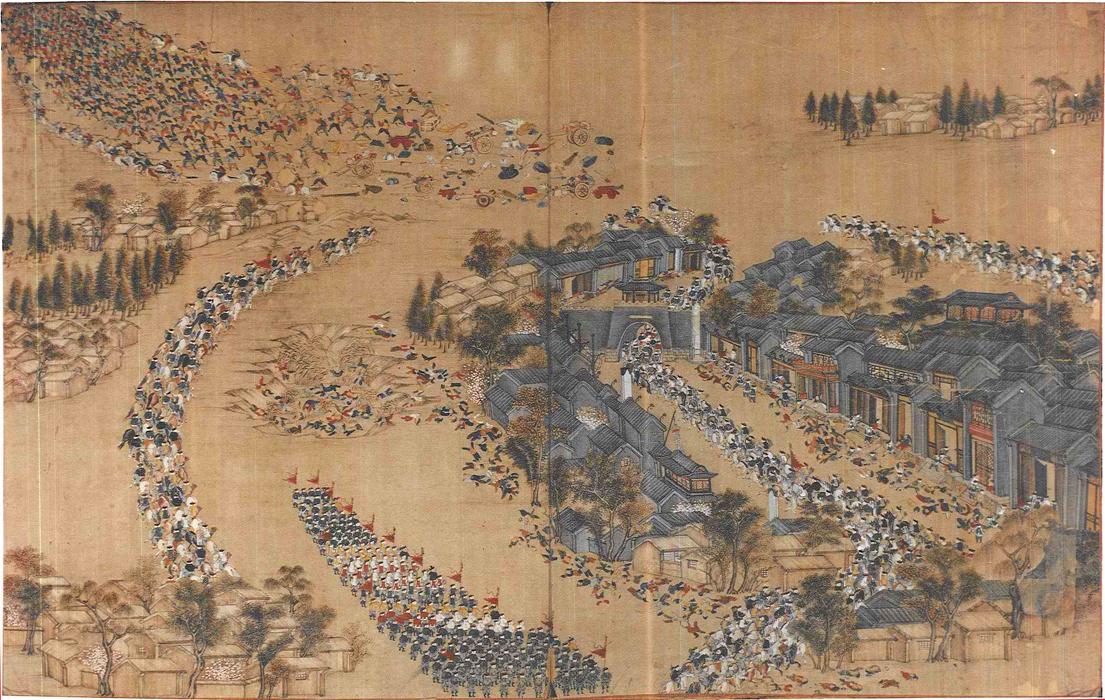
No uprising in Chinese history has had deadlier consequences than the Taiping Rebellion of 1850 to 1864. Led by self-proclaimed prophet and ‘brother of Christ’ Hong Xiuquan, the revolt sought to establish the Taiping Heavenly Kingdom, a utopian realm striving for land reform, social and ethnic equality, and the overthrow of the reigning Qing Dynasty. The uprising quickly swept through China in a cataclysmic wave of bloodshed, claiming approximately 20 million lives. Though the Opium War certainly exposed China’s vulnerabilities - and birthed the infamous treaties of Nanking and Tientsin - the Taiping Rebellion was primarily caused by internal domestic struggles, not external wars and conflicts. Famines and droughts had plagued the Chinese lands since the Ming dynasty. It was this enduring socio-economic instability, compounded by Qing political weakness and channelled through Hong Xiuquan’s ideological influence, that provided the conditions for a radical messianic movement. The Taiping Rebellion was not a direct product of the Opium Wars, but was the culmination of decades of domestic discontent and financial strain, albeit intensified by Western subjugation.
China was no stranger to rebellion even before the Opium Wars, with a reported unusual frequency of uprisings throughout its history. The economic challenges of the Ming and Qing dynasties created an environment of persisting social unrest, encouraging the discontented masses to turn to rebellion to address their grievances. One such problem of the period was the traditional land tenure system, and an “agricultural economy which was being bled to exhaustion by special land taxes levied on the peasantry.” The land tax functioned as a double-edged sword: “it mobilised resources for the state, as well as encouraged rent-seeking by the local elite,” who could consolidate their economic and political power at the expense of the peasantry. Heavy taxation consequently placed further pressure upon an already precarious rural population, and deepened resentment towards regional officials.
The corruption of the bureaucratic system left many peasants without land, or with very small plots. The resulting social hierarchy entrenched inequality, and gradually eroded confidence in the Qing administration. Mao believes that socio-economic inequalities and land disputes were a considerable trigger for uprisings such as the Taiping Rebellion, stating that “the ruthless economic and political oppression of the peasantry, by the landlord class, forced peasants to rise repeatedly in revolt against its rule.” Earlier and contemporary revolts suggest that such grievances were neither unique to the Taiping nor created by the Opium Wars: the White Lotus Rebellion (1794-1804) was initiated as an anti-tax protest, whilst the Miao Rebellion (1854-1873) involved concerns of competition for arable land. The Taiping therefore belonged to a longer tradition of rebellion against fiscal pressure, land scarcity, and ineffective government, complicating any interpretation which treats the Opium Wars as its principal origin.
Demographic pressure aggravated these structural problems. In 1850, the year of the Taiping Rebellion, China’s population had soared to almost 400 million, while the supply of cultivated land per capita sunk to levels lower than the seventeenth century. Population growth placed an increasingly severe strain upon an agrarian economy already struggling with scarcity, food crises, and famine. Wong considered that the government’s failure to meet grain demands, combined with the hoarding practices of local elites, underlay outbreaks of food riots. The appeal of Hong Xiuquan’s promise to overthrow and transform the state must, therefore, be understood within a society in which material hardship had already made the existing political order increasingly difficult to defend. Land scarcity, taxation, ineffective government, and entrenched social hierarchy had sharpened class struggle and generated unrest long before British gunboats arrived on the Chinese coast. The Opium Wars entered an already unstable political landscape; they did not create it.
Nonetheless, the Opium Wars intensified the internal strains from which the conflict emerged. The post-war series of unequal treaties exposed China’s vulnerability to Western subjugation: the Treaty of Nanking opened ports to foreign traders, enforced fixed tariff rates, and ceded Hong Kong to British control. Military defeat therefore carried consequences beyond the battlefield, weakening the prestige of a dynasty already struggling to maintain domestic authority.
The Treaty of Tientsin (1858) - concluded during the rebellion itself - is particularly useful, not as evidence for the Taiping’s original outbreak, but for understanding how foreign intervention aggravated the political crisis in which the rebellion developed. Articles XVIII-XXII continued extraterritorial privileges by outlining the legal status of foreigners and the rights guaranteed to Americans, Russians, Britons and the French residing in China. Extraterritoriality was a consistent topic of contention because the law was “never in practice among European countries, and was an exceptional case in Turkey, Japan, and China.” The arrangement produced an obvious inequality of sovereignty: Britons could sometimes escape Chinese jurisdiction for crimes committed in China, making the Qing government appear incapable of exercising authority within its own territory. Qin Xiaoyi recognised the political significance of the unequal treaties, stating that “nationalism cannot prevail in China unless the ‘self selling indenture’ (the unequal treaties) is abolished.”
The economic consequences of the treaties further intensified existing discontent by opening additional ports to foreign competition, while an expanding Western diplomatic and missionary presence challenged Qing authority. Yet chronology is crucial: Tientsin could not have caused a rebellion which had begun eight years earlier. Rather, the treaty demonstrates how the consequences of the Opium conflicts deepened the crisis of Qing legitimacy after the Taiping movement was already underway. Western intervention was therefore an accelerant of Qing instability rather than its original source.
Structural discontent made rebellion possible, but Hong Xiuquan was able to grant that discontent an ideological form. Born in 1814, Hong was a gifted student who dreamed of restoring his family’s fortunes by passing the Confucian civil service examinations and becoming a Qing government official. After failing the examinations for a third time in 1837, Hong’s visions began, and he eventually interpreted them as divine revelations that he was God’s prophet and the brother of Jesus Christ. His doctrine was political as much as it was religious.
The corrupt Qing government, responsible for high taxes and unequal land division, was commanded by ethnic Manchus, fuelling anti-Manchu sentiments in Southern China and amongst the Hakka community. Being Hakka himself, Hong’s preaching “disparaged the ethnically Manchu rulers as the wrongful usurpers of China,” transforming religious revelation into an argument against the legitimacy of the reigning dynasty. The Hakka were notably marginalised in China; as latecomers, their communities were built on the least fertile land, and they were often subject to abuse and hostilities from local Han Chinese. When Hakkas were forced to compete for water rights as natives burned down their homes in 1850, they “turned to (Xiuquan’s) Society of God Worshippers for protection and support, (causing) the local authorities to view it as a harbour for troublemakers.”
The rapid expansion of the God Worshippers consequently cannot be separated from these local ethnic and material conflicts. For marginalised Hakka communities, Hong’s movement offered not simply salvation but protection, solidarity, and the possibility of a radically different social order. Platt similarly argues that “the Taiping army absorbed the poor and disenfranchised, the criminals, those who feared or hated the Qing authorities, … would commit themselves to the destruction of Confucianism and, above all, the Manchu overlords.” The social composition of the movement is revealing: Hong succeeded because his theology provided a language through which existing grievances could be reorganised into a revolutionary programme. Religion supplied the architecture of the rebellion; dissatisfaction with Qing rule supplied much of its constituency.
Chronology further weakens the argument that the Taiping Rebellion was simply a product of the Opium Wars. Hong Xiuquan’s visions began in 1837, two years before the outbreak of the First Opium War, and culminated in his religious epiphany in 1843, a year after it ended. The intellectual origins of his movement therefore straddled, rather than followed, the first conflict. The First Opium War spanned 1839 to 1842, whilst the Second lasted from 1856 until 1860; the Taiping Rebellion itself began in 1850 and continued until 1864. It preceded the Second Opium War by six years and survived its conclusion by four. This chronology does not render the Opium Wars irrelevant, but it makes a straightforward causal relationship difficult to sustain.
The movement’s origins can be traced to Southern China, where significant Hakka populations and ethnic minorities resided. Southern coastal regions around trading ports, such as Canton, were also particularly exposed to the effects of the Opium Wars and experienced direct military conflict. Yet, geographical overlap does not necessarily establish causation. The same regions were simultaneously characterised by ethnic tensions, economic insecurity, population pressures, and weak Qing authority. Their vulnerability to both foreign intrusion and domestic rebellion may therefore indicate a common underlying problem: the deteriorating capacity of the Qing state.
The strongest counterargument comes from contemporary observers who interpreted the Taiping upheaval precisely through the disruption caused by Western intervention. In an 1853 article for the New York Daily Tribune, Karl Marx proclaimed that the Taiping Rebellion was more than another riot or uprising; it was “one formidable revolution, unquestionably afforded by the English forcing upon China that soporific drug called opium.” Marx’s article highlighted the interconnected nature of relationships within the nineteenth-century industrial landscape, suggesting that British imposition meant that “the authority of the Manchu dynasty fell to pieces; the superstitious faith in the eternity of the Celestial Empire broke down; isolation was infringed.”
Marx’s argument is significant because it identifies a consequence of the Opium War which cannot be measured solely in economic terms: the destruction of political mystique. Military defeat demonstrated that the Qing state was neither invulnerable nor capable of insulating China from foreign power. Unlike interpretations centred upon long-term socio-economic failures, Marx therefore located the collapse of Manchu authority partly in China’s forced encounter with Western capitalism and imperialism. In this reading, the Opium War did not merely add another grievance; it shattered assumptions upon which Qing legitimacy depended.
Even so, Marx’s interpretation arguably assigns too much explanatory weight to foreign intervention. The weaknesses revealed by the Opium War were not synonymous with weaknesses created by it. Agrarian insecurity, ethnic conflict, fiscal pressure, and popular rebellion all predated the conflict, while Hong’s earliest visions themselves emerged before the war began. Western intervention made Qing vulnerability dramatically visible, but this visibility should not be confused with origin.
Ultimately, the Taiping Rebellion was not simply a product of the Opium Wars, but the culmination of long-standing social, economic, and political pressures within Qing China. To attribute its origins principally to foreign conflict risks mistaking an aggravating force for an underlying cause. Hong Xiuquan supplied a unifying religious and political ideology which resonated particularly among marginalised communities, while agrarian crisis, taxation, land scarcity, demographic pressure and bureaucratic corruption had already weakened confidence in Qing rule. These conditions can explain why rebellion occurred, and why Hong’s promise of an entirely new Heavenly Kingdom attracted followers on such an extraordinary scale.
The Opium Wars nevertheless mattered. Military defeat and the unequal treaties exposed Qing weakness, compromised Chinese sovereignty, and intensified existing economic and cultural tensions. Marx was therefore right to recognise that Western intrusion destabilised the traditional political order, but its destabilising effect was so powerful precisely because that order was already under strain. The Taiping Rebellion emerged from the convergence of a long domestic crisis with the newer pressures of foreign intervention. The Opium Wars helped make Qing weakness unmistakable; they did not create the grievances that made millions willing to rebel against it.
Bibliography
Curwen, C. A.. “Taiping Rebel: The Deposition of Li Hsiu-ch’eng.” Cambridge Studies in Chinese History, Literature, and Institutions 82, no.5 (1977): 2.
Gao, James Z.. Historical Dictionary of Modern China (1800-1949). Maryland: Scarecrow Press, 2009.
Goldstone, Jack A.. “The Coming Chinese Collapse.” Foreign Policy 99 (1995): 35-53.
Li, Lillian M.. “Introduction: Food, Famine, and the Chinese State.” The Journal of Asian Studies 41, no.4 (1982): 687-707.
Li, Mu Y.. “Public Finance and Economic Development in a Historical Institutional Perspective: China 1840-1911.” The Journal of Economic History 64, no.2 (2004): 545-548.
Marx, Karl. “Revolution in China and Europe.” New York Daily Tribune. June 14, 1853. Accessed 6 January 2024. https://www.marxists.org/archive/marx/works/1853/06/14.htm.
Platt, Stephen. Autumn in the Heavenly Kingdom: China, the West, and the Epic Story of the Taiping Civil War. London: Atlantic Books, 2012.
Rhee, Hong Beom. Asian Millenarianism: An Interdisciplinary Study of the Taiping and Tonghak Rebellions in a Global Context. New York: Cambria Press, 2007: 163, 172, 186-187, 191.
Treaty of Tientsin. 1856. “Treaty of Tien-Tsin Between the Queen of Great Britain and the Emperor of China.” June 26, 1856. Accessed 2 January 2024. https://en.wikisource.org/w/index.php?title=Treaty_of_Tien-Tsin_between_the_Queen_of_Great_Britain_and_the_Emperor_of_China&oldid=13622827.
Wakeman. Jr., Frederick. “Rebellion and Revolution: The Study of Popular Movements in Chinese History.” The Journal of Asian Studies 36, no.2 (1977): 201-237.
Wang, Yu-Ch’uan. “The Rise of Land Tax and the Fall of Dynasties in Chinese History.” Pacific Affairs 9, no.2 (1936): 201-220.
Wong, R. Bin. “Food Riots in the Qing Dynasty.” The Journal of Asian Studies 41, 4 (1982): 767-788.
Xiaoyi, Qian. “The Harms of the Unequal Treaties to the Chinese Working Class.” 3 (1989): 462-467.
Zedong, Mao. Selected Works of Mao Tse-Tung: Volume III. Peking: Foreign Language Press, 1965.

The author
MA Politics & Contemporary History graduate writing on policy, philosophy, theology, and international relations.
All work by this author →Read next, in History
- Wait for Me, I'm Gone! Alexandra Jane Patterson
- The Illusion of Reform: How U.S. Presidents from Harding to Roosevelt Shaped — and Dodged — Federal Responsibility, 1921–1941 Alexandra Baily
- Discovering Setsu Koizumi: The Muse “Behind” Lafcadio Hearn Nicholas Parlitsis