History · Essay · New this week
Wait for Me, I'm Gone!
Why we have always tried to raise the dead, from Homer’s underworld to Tolkien’s Necromancer, and what that says about grief.
Alexandra Jane Patterson · 16 October 2026
16 October 2026
“Give sorrow words. The grief that does not speak
Whispers the o’erfraught heart and bids it break.”
William Shakespeare, Macbeth
We are always wondering why. Why so soon? Why now? Why like this? Why him? Why her? And why me?
When someone leaves us, the sky changes. More stars appear. A light extinguished somewhere begins to shine again. The question is: why only up there, and not down here, where it used to glow?
In his notebooks, Leonardo da Vinci wrote that “of all human opinions, that is to be reputed the most foolish which deals with the belief in necromancy, the sister of alchemy, which gives birth to simple and natural things.” Right or wrong, for centuries, legends of the dead returning have sustained us with the hope that, even if only briefly, we too might prolong a goodbye. True or not, magic from beyond promises that a soul can be summoned to exist in two places at once. Real or not, the more time passes, the less willing anyone becomes to believe blindly without first seeing how.
But faith in God is blind. Do we need eyes to believe that a mere mortal, too, can rise again?
From N to Ω
“One curious feature of ancient magic is that, no matter which culture it belongs to, its magical rituals and practices are almost identical,” British philologist Irving Finkel has observed. So it was with the practice of communicating with the dead, used across the world as a means of divination. At least, in the beginning. It was believed that once the spirit was no longer bound to the matter of our world, it could travel freely between past and future, revealing knowledge hidden from the present.
From the Greek νεκυία (nekyia), to the Greek νεκρομαντεία (nekromanteia) and Latin necromantia, to the modern necromancy, the name itself did not originally carry an inherently sinister meaning. Above all, it described communication with the dead in search of counsel. In medieval Latin, the alternative spelling nigromantia, suggestive of “black divination,” reflected the increasingly sinister associations of the practice.
In ancient Mesopotamia, the Akkadian eṭemmu named the ghost or spirit of the dead. It belonged to a different linguistic and religious world from Greek necromancy, although both traditions imagined the dead as capable of troubling or informing the living. Biblical tradition, meanwhile, explicitly warns against seeking knowledge from them. Deuteronomy forbids the Israelites to imitate diviners and sorcerers, including “a charmer, or a consulter with familiar spirits, or a wizard, or a necromancer” (18:10–11, King James Version).
But while some cultures rejected the magic of the beyond out of fear that no other being could possess knowledge equal to God’s, the ancient Greeks and Romans believed differently. To them, counsel from the dead was not divine omniscience, but a continuation of human experience – dependent solely on what the soul had seen and learned while it was alive.
Take Me Home
And according to some, life post mortem was a far gentler affair. Classical literature could imagine the dead retaining recognisably human longings, rivalries and memories. Such visions suggest why a conversation with a departed soul might have seemed less like an encounter with a monster than a continuation of unfinished human business.
In Book XI of the Odyssey, Homer describes a ritual for summoning the dead, desperately performed by Odysseus as he searches for a way back to Ithaca. Following the instructions of the sorceress Circe, the hero digs a trench, makes a sacrifice and offers blood to the shades of the dead – the only means by which they can temporarily regain their voices and memories. As the spirits gather around him, he encounters even his own mother, unaware until that moment that she has died. Only then does the blind prophet Tiresias appear, revealing the trials that still await Odysseus and how he might, at last, find his way home.
Journeys into the underworld in search of knowledge, redemption or aid became such a familiar motif among the heroes of ancient Greece that history gave the descent a name: katabasis. And the myth of the singer Orpheus, who descended into the realm of Hades armed with nothing but his music in an attempt to bring Eurydice back, suggests that the dead were not regarded merely as demons, but as beings still capable of compassion – even mercy.
“Double, Double Toil and Trouble; Fire Burn and Cauldron Bubble”
As for necromancers, they rarely relied on words alone to perform a ritual. At Neolithic Jericho, human skulls were removed, modelled with plaster and sometimes given shell eyes. One example in the British Museum dates to around 8200–7500 BC. Archaeologists have connected these remains with possible ancestor veneration, although they offer no evidence that the dead were summoned or questioned. The distance between remembering the dead and attempting to speak to them is considerable. Later, magic circles, talismans, wands, oils, even the clothing of the deceased would all be regarded as means of opening a portal between two worlds.
“My favourite magical ritual is described by an exorcist who wants to see the future,” Irving Finkel recounts. “According to his manual for summoning a ghost in a cellar, this is how you do it: you take a skull, put it on a table and set fire to it. Let it smoulder for a while, create a bit of atmosphere. Then you take an oil – not just any oil, you won’t find it in the shops, a special oil – and anoint the skull with it. The Sun God then brings the ghost of the dead person out of the beyond, places it inside the skull and lets it speak.”
It is no coincidence that so many necromantic rituals begin with the skull. Before death, it was considered the dwelling place of the human voice and memory. And so, when the soul returned, it first sought out its final home. After the Maenads tore Orpheus limb from limb, legend tells us that his severed head continued to sing and prophesy as the current of the River Hebrus carried it away. Even the skull of the Byzantine emperor Nikephoros I, killed at the Battle of the Varbitsa Pass in 811, was said to have been encased in silver and fashioned into a ritual drinking cup. Far removed from necromancy though it was, Khan Krum’s command nevertheless reveals how widespread the belief was that some part of a person’s strength, memory and spirit could remain bound to their remains long after death.
Not every ritual promised a voice from the grave. Ancient accounts also describe attempts to compel the dead to reveal secrets through tombs, corpses and skulls. The imagined encounter could be intimate or terrifying: an appeal for guidance, or an effort to force an answer from a being who could no longer refuse. Medieval manuals would later make this coercive ambition still more explicit, prescribing circles, conjurations and carefully timed ceremonies to summon spirits and command their appearance.
Of the Father, and of the Son, and of the Holy Demon
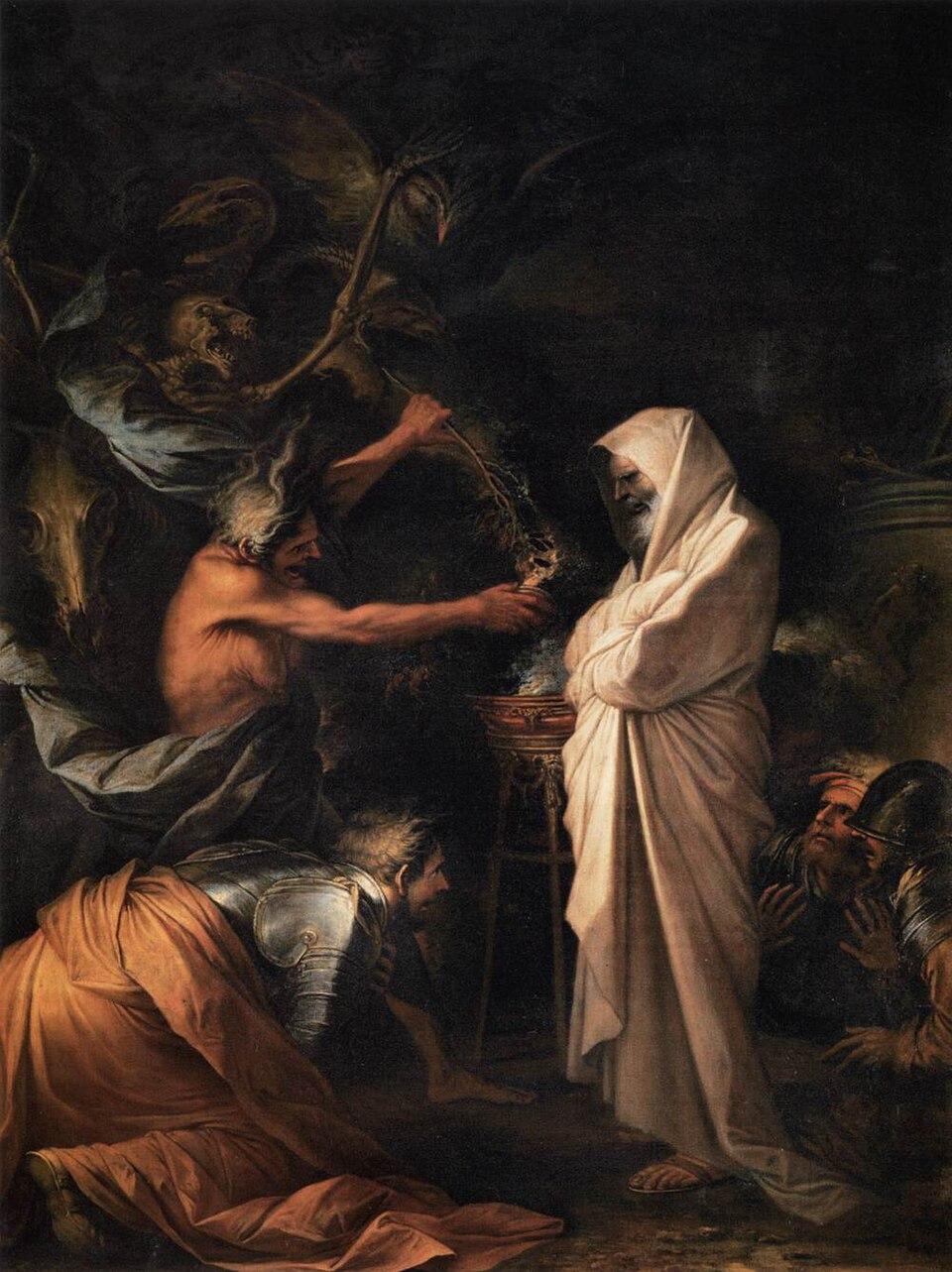
By the Middle Ages, Christian writers had inherited a much older biblical prohibition, but interpreted the summoning of the dead through increasingly elaborate ideas about demons and forbidden magic. In the Old Testament, Mosaic law condemns consultation with the dead; the prohibition itself suggests that the practice was familiar enough to require warning. In the First Book of Samuel, Saul, the first king of Israel, secretly visits the woman of Endor and asks her to summon the spirit of the prophet Samuel – even though he himself had outlawed necromancy throughout his kingdom. A battle against the Philistines is approaching, and God refuses to answer him. And when the light will not respond, it is the shadow’s turn.
Over the centuries, the emphasis of the story shifted. In the biblical account, the central figure is the transgressive ruler Saul, willing to violate his own law in his hunger for knowledge of the future. The woman is described as someone with a familiar spirit; later Christian retellings and artistic traditions increasingly cast her as the Witch of Endor. The label reflects the story’s long reception rather than a transformation that can be dated to a single century. A story about the corruption of a ruler could thus become a warning about the danger posed by those who claimed to summon the dead.
The greatest theological dilemma, however, lay elsewhere. To the ancient Greeks and Romans, the dead were simply the dead. The soul of Tiresias was Tiresias; the soul of Orpheus was Orpheus. Medieval theologians were not so certain. If the human soul belonged to God after death, how could a necromancer possibly bring it back?
According to many Church writers, true resurrection was possible only through the will of God. The creature that appeared during a necromantic ritual, therefore, was not the spirit of the deceased at all, but a demon wearing its likeness. And so necromancy gradually ceased to be merely a conversation with the dead and became a form of demonology.
In medieval discussions of illicit magic, maleficium meant harmful magic; it did not, by itself, imply deception. And yet this did not stop educated clerics from secretly practising necromancy themselves. They could read Latin, had access to manuscripts, and combined their knowledge of astrology, demonology, exorcism and theology.
As a result of this intrusion of the divine, medieval necromancy became a peculiar synthesis of Arabic astral magic and Christian ritual practice. The phases of the Moon, the positions of the planets, and particular days and hours began to play an important role in its rituals. At the same time, psalms, biblical passages, prayers, and the names of angels and saints found their way into its incantations.
The Munich Manual of Demonic Magic describes such rites in meticulous detail. Circles were drawn upon the ground, cloth or parchment and filled with symbols, letters and images that blended Christian and occult traditions. They were believed to function as fortresses, protecting the necromancer from the very beings he summoned. The incantations themselves were repeated over and over, often accompanied by prayers and particular movements of the body, until the demon was compelled to appear.
The new necromancers craved three things: knowledge, illusion and power. They wanted to know the future, conjure apparitions and bend the will of others. Advice was no longer enough to ask of the dead.
Necromancy had become a means of controlling the world.
“Servant and Master Shall Be Reunited Once More”
“There is no good and evil. There is only power, and those too weak to seek it,” Quirrell repeats, in the words of his master, Lord Voldemort, in the British Harry Potter series. His very name derives from the French vol de mort – “flight of death,” or, alternatively, “flight from death.” And indeed, the villain spends his existence postponing the end. Unlike the ancient necromancers, who accepted human mortality, Voldemort repeatedly splits his soul through murder and hides its fragments in objects known as Horcruxes.
Several decades earlier, another British author created perhaps the most recognisable symbol of necromancy in modern fantasy literature. Although J. R. R. Tolkien rejected the idea of absolute evil, he acknowledged that Sauron of The Lord of the Rings had come as close to it as was possible. And before he became the all-seeing Eye of Mordor, the villain was known simply as the Necromancer.
In Morgoth’s Ring, Tolkien describes the fate of wayward spirits as a miserable one, consumed by envy and self-pity. They bring neither truth nor wisdom to the living, only ill omen. And yet, in The Return of the King, Aragorn still manages to persuade an army of the dead, condemned to remain trapped somewhere between the substance of life and death, to join the fight against evil so that they might atone for their sin and depart with honour.
Perhaps, then, not every hope of goodness within necromancy has been extinguished entirely.
Good or evil, it survives. In one form or another, the art of the afterlife has found its way into almost every culture, every religion and every age. Because when someone we love leaves us, a prayer that they are somewhere up in heaven is not always enough.
We need to believe in a little magic, too.
Something to soothe the grief, to postpone the acceptance that when someone is gone, they are no longer here.
Bibliography
Bible, The Holy. King James Version. Deuteronomy 18:10–11; 1 Samuel 28.
British Museum. “How to Perform Necromancy with Irving Finkel.” Video. https://youtu.be/Oq2ccSZkmn8
British Museum. “Mesopotamian Ghostbusting with Irving Finkel.” Video. https://www.britishmuseum.org/collection/death-and-memory/mesopotamian-ghostbusting-irving-finkel
British Museum. “What Lies Beneath: New Discoveries about the Jericho Skull.” https://www.britishmuseum.org/blog/what-lies-beneath-new-discoveries-about-jericho-skull
Crampton, R. J. A Concise History of Bulgaria. 2nd ed. Cambridge: Cambridge University Press, 2005.
Homer. The Odyssey. Translated by Robert Fagles. London: Penguin Classics, 1996.
Kieckhefer, Richard. Forbidden Rites: A Necromancer’s Manual of the Fifteenth Century. University Park: Pennsylvania State University Press, 1997. https://doi.org/10.5325/jj.5233075
Ogden, Daniel. Greek and Roman Necromancy. Princeton: Princeton University Press, 2001. https://www.jstor.org/stable/j.ctvs32rs3
Pseudo-Agrippa. Fourth Book of Occult Philosophy. Translated by Robert Turner. London: J. C. for John Harrison, 1655. https://wellcomecollection.org/works/zgvs7b2r
Rowling, J. K. Harry Potter and the Philosopher’s Stone. London: Bloomsbury, 1997.
Rowling, J. K. Harry Potter series. 7 vols. London: Bloomsbury, 1997–2007.
Shakespeare, William. Macbeth. Edited by Sandra Clark and Pamela Mason. Arden Shakespeare, Third Series. London: Bloomsbury, 2015.
Tolkien, J. R. R. The Lord of the Rings. London: George Allen & Unwin, 1954–55.
Tolkien, J. R. R. Morgoth’s Ring. Edited by Christopher Tolkien. The History of Middle-earth, vol. 10. London: HarperCollins, 1993.

The author
Alexandra Jane Patterson is a journalist, editor and literary translator who began working in journalism at sixteen. Her writing has appeared in Steeze Magazine, L’Europeo Bulgaria and Variety, among others, and she is drawn to stories about memory, grief and identity.
All work by this author →Read next, in History