
History · Essay · The Weekly, No. 5
How Did Stalinism Transform the Purpose of Soviet Art, 1924–1932?
The fate of revolutionary art after Lenin.
Chanel Parker · University of Nottingham · 5 September 2026
University of Nottingham · 5 September 2026
It is an absurd cultural paradox that the dynamic art movements of post-revolutionary Russia gave birth to one of the most draconian and restrictive crusades of the early twentieth-century. Vibrant artistic expression had thrived under Lenin’s rule, when ‘the people’s art’ served to enlighten the liberated proletariat, and depict the political agitation of the revolution through striking avant-garde works of sculpture, literature, and painting. From the Artists’ Union of the USSR to the decree ‘On Restructuring Literary-Artistic Organisations’, the flamboyant cultural landscape proved only temporary, and Stalin’s ascent to power was accompanied by prescriptive ideas about the purpose of art, leading to the weaponisation of creativity as a propaganda tool for the new Soviet State. The transformation was more complicated than the suppression of one aesthetic by another, since the revolutionary belief in art as an instrument of social change endured but became increasingly bound to the demands of the Stalinist regime. By 1932, Soviet art had acquired a more authoritative purpose: to give socialism a recognisable form, and reconcile the society promised by revolution with a more difficult reality.
Art, in the early years of the Soviet Union, was predominantly unrestrained. The Bolshevik Revolution of 1917 had set culture aflame and proclaimed, for the very first time in Russian history, that all peoples had a right to self-determination. Promises of liberty and autonomy sparked an extraordinary period of experimentation, ranging from abstract innovation to overt political critique. Though Lenin himself favoured more traditional and patriotic works, which depicted the ‘New Soviet Man’ as the stepping stone towards a socialist utopia, he remained broadly supportive of the flourishing artistic scene, recognising art’s growing popularity as a means to communicate his ideals to the masses. His insistence that “art belongs to the people” left considerable latitude over what revolutionary culture might actually look like. Whether his tolerance came from conviction or is better attributed to the immediate demands of the revolution, it created fertile ground for artists such as Pesvner and Gabo, and for movements as disparate as Futurism, Constructivism, and Suprematism.
When the Russian Civil War ended in 1922, Stalin began consolidating his power as General Secretary, which necessitated an increasingly interventionist approach to Soviet culture and a gradual movement towards principles later associated with Socialist Realism. By tactfully manipulating the Constructivist art theory, which thrived under Lenin until his death in 1924, Stalin retained its emphasis on art as educational and functional but subjected these principles to increasingly prescriptive demands. Works were expected to be optimistic and propagandistic, presenting Soviet life favourably and glorifying its political leadership. Yet, the belief that art could actively participate in the creation of a new society was itself a Constructivist inheritance. Thus, it was determined that art required no new political function so much as a narrower definition of the society it was expected to serve.
From 1925, Stalin appointed Communist professors to art schools as a matter of policy, ensuring that political agendas bled through into students’ artworks as the commissioning of art became more widespread. Under Lenin’s rule, Futurists were able to profit from leftist abstract art as a result of the NEP, but the government’s installation of Communist teachers ensured an element of control over the works being produced and was the first step towards preventing the publication of unpatriotic art pieces - even before the passing of any laws. Alongside this, the AKhRR, which had promoted the work of Russian Realist group ‘the Peredvizhniki’ since the 1860s, faced increasing pressure from political forces in the mid-1920s over the wavering definition of what Realism permitted. The AKhRR had previously painted with unflinching honesty, drawing upon the struggles of Red Army soldiers and rural peasants to depict the hardships of working life. This commitment to observation became increasingly awkward as optimism acquired political value, and truth became increasingly difficult to sustain.
Now living in the seemingly liberated, post-revolutionary era they once longed for, the Stalin-led shift towards new Socialist Realism urged artists to compromise their depiction of a gritty and brutal reality, and instead create art without critique to maintain a façade of achieved equality. The worker remained at the centre of Soviet art, although the purpose of representing him changed. Hardship receded from the permissible image of working-class life, as productivity, equality, and collective fulfilment acquired greater prominence. Art thereby participated in the construction of Soviet reality, presenting the worker according to the ideological expectations placed upon him and encouraging the viewer to recognise that ideal as something already taking shape.
The Proletkult, an experimental artistic institution during the revolution, had similarly switched ideologies and committed themselves to the production of exclusively industrial art and literature by 1924. Though the promotion of Socialist Realism remained informal at this time, the Proletkult’s “independent activities were curtailed by government intervention, and the pernicious effects of doctrinal generalisation.” The warning that “the visual art of the new world will be productional, or there will be none at all” further suggests that artists adapted partly through self-preservation, rather than from genuine attraction to the romanticisation of Realism. The narrowing of Soviet culture therefore preceded its formal reorganisation: institutions and patronage could discipline artistic production before doctrine acquired the force of law.
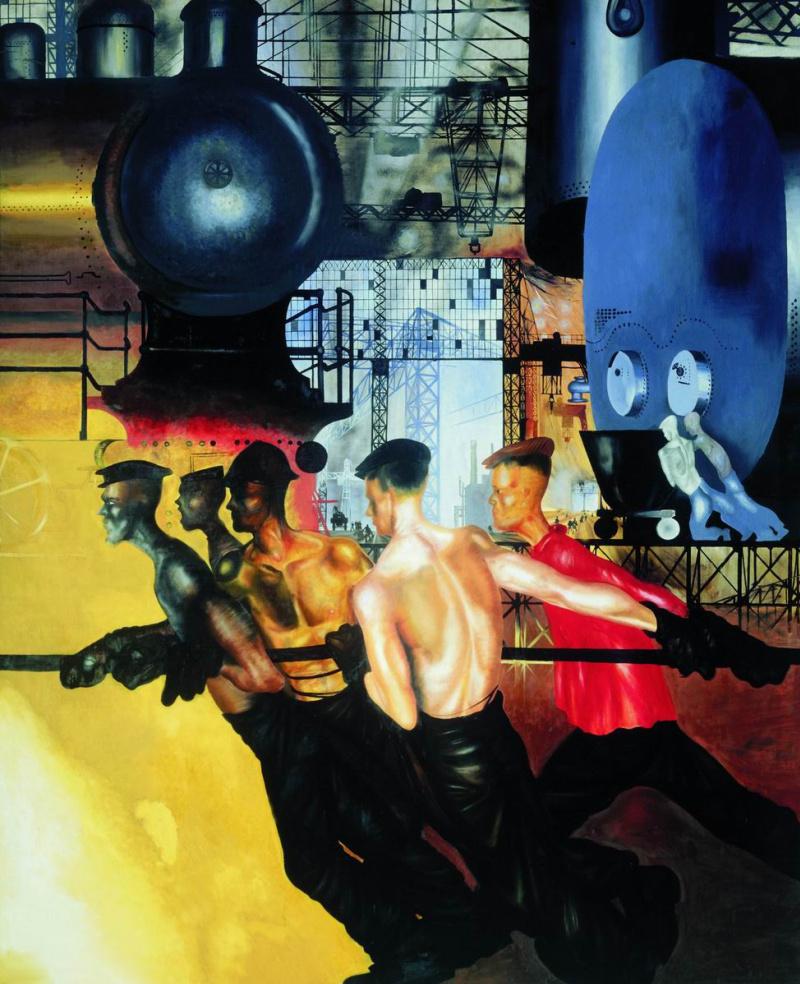
Such changes in art encouraged the glorification of collective human labour in the Soviet State, as is represented in Yuri Pimenov’s painting Increase the Productivity of Labour. Pimenov renders his workers in a restricted yet glorious palette of red and gold, lending industrial labour a monumental quality while the human figures themselves appear rigid and depersonalised. Their bodies merge visually with the machinery surrounding them, collapsing the distinction between worker and industry. The resulting ‘New Soviet Man’ derives his heroic character from his complete integration into collective production. This example differs greatly from post-revolutionary avant-garde works, which were often critical of the political climate, and used abstract methods to express grief over the revolution and its subsequent quality of life. Produced in 1927, the painting also demonstrates that the emerging aesthetic remained less doctrinally settled than it would become after 1932. The arts remained only loosely connected to the totalitarian regime before 1930, allowing considerable variation to persist in the meanings of individual works.
Pimenov's ‘New Soviet Man’ also exposes a tension between individuality and the collective. His perfection is expressed through productivity, uniformity, and integration into a larger industrial whole, so that individual distinction becomes almost incompatible with the ideal being celebrated. The revolutionary ambition to create a new human being therefore survived into Stalinist culture in a markedly restrictive form. Art could supply an image of the person that Socialism promised to produce and, in doing so, offer the viewer a model against which to understand himself.
The ultimate goal of Marxist-Leninist ideology was to make the population “not just aware of Socialist principles, but to adopt them as their own, and work harmoniously towards their achievement.” Propaganda also needed to become more accessible due to the agrarian nature of Soviet society and low literacy levels. As this new method of education came to prominence in 1927-1930, the image of the leader simultaneously rose in importance; Stalin’s strong cult of personality can be vastly accredited to his depiction in late 1920s to early 1930s artwork, and is considered to be one of the reasons that he so strongly led the movement towards Socialist Realism. As of 1929, most of Stalin’s portraits were commissioned under kontraktatsiia, meaning that the regulation of circulation and authority over artistic methods were centralised under State control. Repeated images gave visible form to political abstractions which might otherwise remain remote: socialism became legible through the worker, progress through the factory, and political authority through the leader. This differs from 1917-1924 post-revolutionary Russia because, although Lenin did not personally approve of all genres of art and literature, his conviction that art should belong to the people had accommodated considerable aesthetic variety. Under Stalin, that variety survived under very different conditions, as the State acquired increasing influence over what was produced in the name of the people.
Following the paternalistic traditions of Russian art, Stalin was portrayed as a father-figure in Soviet propaganda posters and novels, and was represented as the ideological heir of Lenin in an attempt to capitalise off his legacy. Since “experimental art emphasised individualism, and was in basic conflict with Collectivism”, Stalin could instead be presented as a symbolic persona of the Party, rather than simply as an individual leader. Bukharin captured this distinction when he remarked of Stalin: “He (is) not trusted, but he (is) the man whom the Party trusts; he is the symbol of the Party.” Stalin’s image gave the Party a recognisable human form and made political authority visible. This creates an interesting inversion of Pimenov’s ideal worker: individuality receded into the collective in one, while the collective acquired an individual face through the other.
In 1932, the Central Committee of the Communist Party issued the decree ‘On Restructuring Literary-Artistic Organisations.’ This forcibly disbanded all artistic and literary organisations, consolidating them under the now officialised art style of Socialist Realism and crushing competition in order to establish full government control. If art were not “Proletarian, Typical, Realistic, and Partisan,” the government would not recognise the work, nor supply the artists with regular income. Stalin had long despised avant-garde works as inaccessible, and the founding of the 1932 Artists’ Union of the USSR signified the end of this modernised and progressive era. The decree thus formalised developments already visible throughout the preceding decade. By abolishing competing organisations, it also curtailed institutional disagreement over the function of revolutionary culture: where artists had once debated how art might serve socialism, the State increasingly supplied the terms of that service.
Overall, Stalinism substantially transformed the purpose of Soviet art between 1924 and 1932. Censorship and the decline of artistic pluralism were central to this process, but they existed alongside an important continuity. The revolutionary conviction that art could educate, influence, and participate in the creation of a new society did not disappear with Lenin. Instead, the freedom to determine what that society should look like became increasingly restricted. Socialist ideals were given more definite and politically useful forms, while the boundaries of acceptable representation steadily contracted. The reforms of 1932 ultimately formalised a transformation that had developed gradually throughout the preceding decade, bringing forth an existing faith in art’s social function within a more closely prescribed political framework.
Bibliography
Bowlt. J. E. (1971). ‘Russian Art in the Nineteen Twenties’, Soviet Studies, Vol.39(4), pp. 575-594.
Bown, M. C. (1991). Art Under Stalin. Teaneck: Holmes & Meier Publishers.
Dan, L. (1964). ‘Bukharin o Staline’, Novyi Zhurnal, 75.
Ellis, A. (2012). Socialist Realisms: Soviet Painting 1920-1970. Milan: Skira Editore.
Gill, G. (2011). Symbols of Legitimacy in Soviet Politics. New York: Cambridge University Press.
McLanthan, R. B. K. (1959). ‘Art in the Soviet Union’, The Atlantic (June 1960 Issue).
Pimenov, Y. (1927). Increase the Productivity of Labour. Oil on canvas. Moscow: State Tretyakov Gallery.
Pisch, A. (2016). The Personality Cult of Stalin in Soviet Posters, 1929–1953: Archetypes, Inventions and Fabrications. Canberra: ANU Press.
Pletnev, V. (1922). ‘Na ideologicheskom fronte’, Pravda.

The author
MA Politics & Contemporary History graduate writing on policy, philosophy, theology, and international relations.
All work by this author →Read next, in History
- Wait for Me, I'm Gone! Alexandra Jane Patterson
- The Illusion of Reform: How U.S. Presidents from Harding to Roosevelt Shaped — and Dodged — Federal Responsibility, 1921–1941 Alexandra Baily
- Discovering Setsu Koizumi: The Muse “Behind” Lafcadio Hearn Nicholas Parlitsis