

Politics · Essay · From the archive
US Withdrawal from Afghanistan: Causes and Consequences
Why did the US withdraw from Afghanistan and what were the repercussions of this decision?
Mark Cusack · 11 September 2026
11 September 2026
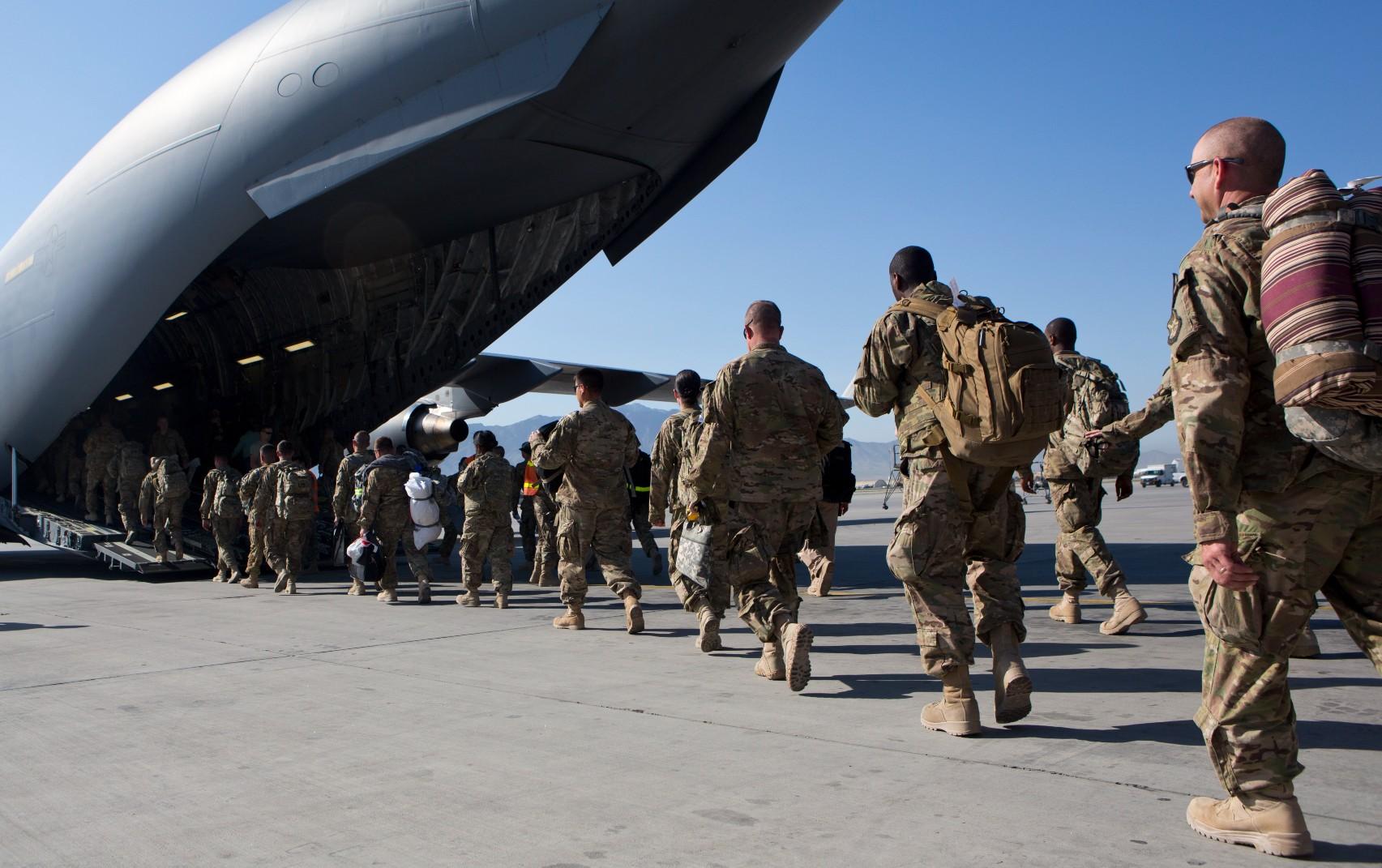
In the August of 2021 the United States of America withdrew its forces from Afghanistan after twenty years of military involvement which had begun in the aftermath 9/11 Terror Attacks. In this it followed the unsuccessful attempts by the British Empire and Soviet Union to impose their ideology and vision of society on this comparatively small Middle Eastern nation. The reasons for withdrawal are complex and its consequences are manifold, but this essay will explain the primary reasons why the US made the choice to withdraw and what the short and long-term consequences of this decision have been.
Causes
The perception by policymakers that main objectives for military intervention had been reached much earlier than 2021 was an important factor in the decision to withdraw. When President George W Bush had launched military operations in 2001 it had been to track down and punish those responsible for the 9/11 terror attacks from the extremist Islamist group Al Qaeda led by Osama Bin Laden. After the failed Soviet invasion in the 1980s a civil war broke out which resulted in much of Afghanistan becoming ruled by the reactionary Islamist group known as the Taliban who hosted many extreme Jihadist groups such as Al Qaeda. In September 2001 Bush sent an ultimatum to the Taliban demanding that they shut down all terrorist training camps within their territory and hand over those responsible for the 9/11 attacks. When the Taliban rejected these demands, President Bush warned in his address to the joint sessions of congress that “we will pursue nations that provide aid or safe haven to terrorism. Every nation, in every region, now has a decision to make. Either you are with us, or you are with the terrorists” as invasion preparations began. The main objectives were to destroy terrorist capabilities within Afghanistan and punish the leaders of Al Queda. That the Afghan people might be free of Taliban rule in a regime change was seen as a positive side-effect but was not the primary motivation even if it later became an objective. Although Afghanistan was quickly pacified in the aftermath of the invasion as the Taliban evacuated into the mountains, it took ten years to finally complete a main goal of neutralising Bin Laden who had fled to Pakistan but was killed in an operation under President Obama in 2011. With Bin Laden dead the Americans undertook a process of nation building but were unwilling to remain in Afghanistan indefinitely. The Americans supplied and trained the Afghan army, with an estimated $80 billion, to defend their state against future threats from the Taliban. There was little more reason for US ground troops to remain especially when it was believed that the new Afghan state and military had the resources to protect itself.
The continued occupation of Afghanistan also brought a huge financial commitment, which many American officials were keen to relinquish. There was a much higher cost to maintaining US bases and troops in Afghanistan compared to other US allies due to the scope of operations and the perennial threat from the Taliban and Jihadist groups. To compare with an US ally such as Japan from 2016-2019 it cost $5 billion to maintain 55000 troops while in the same period in Afghanistan it costed more than $40 billion to support 9000 – 13000 soldiers. This shows how it was impossible to bring Afghanistan into the worldwide installations of American military bases at an acceptable cost. As well as military spending the USA was spending huge amounts of money to subsidize the Afghan government as well as humanitarian spending. Involvement overall is estimated to have been more than $900 billion, a cost that policymakers did not want added to. During the 2010s the large costs of American intervention may have been seen as necessary but with the economic downturn caused by the Covid-19 epidemic to the American economy in 2020 this rapidly changed the situation as well as the growing deficit in the federal budget. This heavily impacted the American decision to withdraw as the US government was wasting huge amounts of taxpayers’ dollars to prop up Afghanistan, a cost deemed unnecessary twenty years after the initial invasion.
Another reason which influenced the US decision to withdraw were the nature of the presidential administrations. The President of the United States is the key decision maker in foreign policy and therefore the policies of the administration or personality of the commander in chief are important factors when understanding why American intervention in Afghanistan ended. President Barack Obama’s administration toyed with the idea of withdrawal but were concerned that the Afghan government was not yet strong enough to stand by itself and wanted to complete the project of nation building. This opinion was strengthened by the recent withdrawal of Iraq in 2011 which led to the rise of ISIS and renewed American intervention as a result. When Donald Trump ran for the presidency one of his key promises to voters was to end “forever wars” in the Middle East and advocated withdrawal arguing that that the nation building project undertaken previously had been a mistake. Despite this for the first part of his presidency Trump actually increased troop numbers and expanded operations highlighting the rather incoherent and unpredictable way in which his administration made decisions. Still Trump viewed himself as a master negotiator shown by his famous autobiography “The Art of the Deal” and pushed through to make an agreement with the Taliban to allow US forces to leave. This culminated in the Doha agreement signed in February 2020. This agreement handed many wins to the Taliban. It brought them to the top table thus legitimising them, it prohibited them from attacking US forces but not Afghan forces, it agreed a release for 5000 of their political prisoners and fighters and set a timeline for American withdrawal rather than a general peace for Afghanistan. When Joe Biden was elected president he decided to follow Trump’s deal believing that America could not stay in Afghanistan forever, commenting that “only the Afghans have the right and responsibility to lead their country, and that more and endless American military force could not create or sustain a durable Afghan government”. None of the three administrations post-Bush had a coherent long-term strategy on how to win the war and were unwilling to maintain a permanent presence due to the political poisonous reputation which so called “forever wars” had gained among the American electorate.
The changing geo-political landscape changed American priorities in its assessment of Afghanistan with the rise of China. While many including President George W Bush had posited that terrorism would be America's defining conflict of the twenty-first century, in a similar way that global communism was during the twentieth century, but after the sour results of the war in Iraq it became clear that this was not the case. Islamic terrorists were able to impose large casualties with relativity little resources but not the extreme threat that could bring down the West that Bush and others claimed. Instead, a much more tangible and traditional threat began to draw the attention of American policymakers. The Peoples Republic of China had grown exponentially in terms of its economic and political influence from the 1990s to the 2010s and many estimates assume it will overtake the US as the biggest economy in the near future. China was beginning to prove the biggest threat to America’s hegemony of the liberal world order since the collapse of the Soviet Union. Continued American military intervention seemed illogical as Afghanistan had little strategic importance against China and the focus on the Middle East began to fade during the Obama administration in what is known as the “pivot to Asia”. Military resources being wasted on Afghanistan were better off being used to sure up Americas positioning against China in east Asia, which is expected to be the main zone of conflict between the two nations in any future confrontation. Withdrawal therefore made sense in the strategic realignment which was taking place and making a traditional great power rivalry take precedence over the threat of global terrorism.
Consequences
The most immediate effect of Americas withdrawal from Afghanistan was the return of the Taliban to power. As American Forces began their withdrawal in May 2021 the Taliban began offensive capturing the countryside and villages across the country, facing little resistance from the Afghan army. As the government and military faced collapse Biden reiterated that the USA would not intervene, his belief being that if Afghans would not risk their lives to keep the freedoms that the US had secured for twenty years then why should Americans give theirs? On the 6th of August they began a large-scale offensive on the major provincial capitals. They allowed American and NATO forces to withdraw both their military and civilian personal before completing their final victory on the 15th with President Ashraf Ghani fleeing the country. In scenes reminiscent of the fall of Saigon in 1975 Afghan civilians and those who served with the Americans clamoured at airports to join the evacuation. Twenty years of nation building went down the drain as the political and militarily structures which the USA had built with great expense had collapsed in just over a week. The Taliban was back and stronger than they had been in 2001. They now had access to billions of dollars’ worth of American military equipment which had been abandoned by the Afghan Army and remained undamaged. In 2001 the Taliban contested control of Afghanistan from a group known as the Northern alliance but in 2021 they faced no such opposition and began imposing their vision of how society should operate.
The restoration of the Taliban started downturn in the humanitarian situation and the disappearance of many basic human rights. The Taliban turned Afghanistan into a religious theocracy, following their strict interpretation of Islamic sharia law. While at first the Taliban insinuated their rule would not be severe as in the 1990s but they gradually dropped this facade as they gradually brought in stricter laws. Afghan Women were the greatest victim under the new government. In the previous twenty years they had given many rights and liberties which in the West are seen as basic. Under the Taliban they face severe restrictions as they are banned from education after a certain level, banned from employment except in specific professions, in public they have to wear the Burqa to cover their bodies from head to toe and they also face serve restrictions on mobility without a man. Th United Nations human rights chief has commentated that “The de facto authorities have, in effect, criminalized the presence of women and girls in public life”. Many nations have also stopped funding humanitarian spending as to prevent funds falling into the hands of the Taliban and the World Bank and International Monetary Fund froze most of Afghanistan’s foreign assets. As a result of this Afghanistan remains one of the largest humanitarian catastrophes in the world with 21 million, half the population, projected to need assistance as they face food insecurity and even starvation. This was a major impact of the withdrawal as this rapid collapse in humanitarian standards would not have occurred if the Americans had stayed.
The withdrawal increased instability in the region, inside Afghanistan itself and even globally. Despite implementing a fairly strict form of sharia law, for many extreme Islamic groups this was not enough. ISIS-Khorasan, which seeks to create a global caliphate, were unhappy with the Taliban’s consolidation within Afghanistan and its reluctance to start a global Jihad. When the Taliban retook power their terrorist cells immediately launched attacks, including one in a hospital in Kabul in November 2021 which killed 19 people and wounded 50. The existence of ISIS-K and other extreme Islamic groups has created the prospect that Afghanistan could once again become a hot bed for Islamic terrorism despite the Taliban’s promise that it would not allow its territory to be used for terror attacks abroad. Relations between the Taliban and Pakistan also have begun to deteriorate rapidly. Despite previously aiding the Taliban, the Pakistani government began strikes on Afghanistan in February 2026 response to terror attacks which it claims were as result of the Taliban’s failure to stop extremists. This was overshadowed internationally by the recent conflict between Iran and the USA. These events internally and externally show there is a significant risk that Afghanistan could once again becoming a hub of terror, with the Taliban unable to prevent this even if they were willing to, or that further conflicts could breakout with neighbouring nations who do not want this instability spreading into their borders.
The withdrawal also proved to be a profound shift in showing the limits of American Power. The United States was humiliated even if it retained the strongest militarily in the world. Its policies in the war on terror and nation building had been shown to be sham. This signalled different messages to America’s allies and enemies. After the 9/11 attacks America used NATO’s article five for the first time in its history, meaning that many NATO soldiers fought and died alongside the Americans. Despite this effort NATO was not fully consulted when making the decision and preparations to withdraw leaving many allies in the dark and causing confusion and unreadiness when it came to the evacuation. With Afghanistan proving to be a failure this has left many Allies anxious not to follow more adventurism in the Middle East as shown with the current reluctance to get involved in the current conflict in Iran. This has been compounded by vice-president Vance’s remarks that underplayed America’s ally’s role in the war and undermining the legacy of those who sacrificed their lives, adding further fractures to an already splintering alliance. The Chinese and Russians also looked on the withdrawal with great interest. The President of the Russian Federation, Vladamir Putin, views events through his own warped view of history and most likely saw the parallels between Americas withdrawal and the Soviet Union’s own botched invasion in the 1980s. The withdrawal may have impacted his decision to invade Ukraine just a few months later in February 2021 seeing this moment of perceived weakness and disunity of the West as the perfect opportunity to start a war. The withdrawal also showed China that the US lacked resolve or credibility and may be willing to test if the American’s are willing to defend Taiwan in the future. The Chinese government also immediately began diplomatic relations with the new Taliban government, downplaying its links to terrorism as it sees Afghanistan as the perfect hub to help spread economic and political influence throughout the Middle East. This is an important consequence of the decision to withdraw as it has hurt The USA’s reputation and credibility in the eyes of both its closest allies and fiercest enemies.
Conclusion
Inconclusion there are various reasons why the United States chose to withdraw. In the eyes of policymakers the objectives had been completed, there was the huge cost involved in continued intervention, the rise of China was deemed more important and there was no long-term strategy in Washington on how to exit Afghanistan successfully. The impacts of the withdrawal have been felt within Afghanistan itself with the return of the Taliban and the deteriorating humanitarian situation as well as globally with the risk of renewed terrorism and the damage to the global reputation of the USA. The US could now follow the path of either of its predecessors in Afghanistan. For the British Empire Afghanistan was a minor blip despite their disastrous and humiliating retreat from Kabul in 1842, but it continued to be the world's premier power for the next fifty years. For the USSR Afghanistan contributed in part to its demise as a superpower with its huge economic cost and the loss of credibility of the Soviet government and armed forces to the peoples of Eastern Europe, who they dominated. Historians in the future could point to the withdrawal as the end of American dominance and the birth of a new multi-polar world or perhaps it will be remembered as nothing more than a footnote in the continuation of the “Pax Americana”.
The author
Recent graduate in BA History and International relations from Queen's University Belfast
All work by this author →Read next, in Politics