
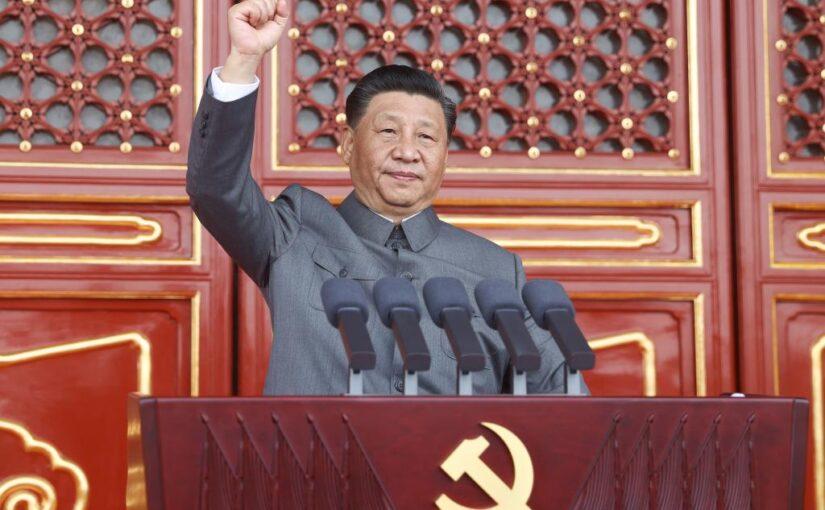
In their 2026 book, China’s Global Strategy under Xi Jiping, Steve Tsang and Olivia Cheung cite a 2023 article by Darren J. Lim and G. John Ikenberry that defines the three principles of what they call a China-led hegemonic order:
The first principle is the “logic of difference,” which provides “a much greater degree of freedom for states to decide their own policy settings.” The second is the “logic of win-win,” which is “embodied in engagement strategies that focus overwhelmingly on economic relationships.” The third is the “logic of partnership,” in which “cooperation is structured around informal partnerships rather than formal institutions, and where disputes are resolved between the parties involved.”
I realize that from the CCP’s standpoint, Taiwan is part of China, not a separate state. Its attitude toward the KMT, the ROC’s more China-leaning political party, suggests that the CCP is more comfortable dealing with the Taiwan question as an interparty matter. That creates a possible way forward that doesn’t involve either a hostile takeover through invasion, all too reminiscent of the Russian Federation’s invasion of Ukraine, or an assimilation along HK lines that tore up the agreement hammered out with the UK prior to handover.
The real brake on China’s actions in reference to Taiwan is the Global South it hopes to win over to Xi’s vision of China’s pre-eminence (as Tsang and Cheung style it). While they assert that an invasion that humiliates the standing of the US as a global hegemon is on the table, the slippage in standing that the Trump regime has accomplished on its own may make that ambition moot.
According to Tsang and Cheung, an important part of Xi’s strategy is to avoid the hegemonic trap of taking on the role of “global policeman” assumed by the US after 1945. While it poses the Taiwan question as a purely internal matter, the ROC is a viable and prosperous democracy that traces back to the 1911 revolution. (The KMT’s claims as a political party predate the CCP, but both have roots in the movement started by Sun Yat-sen in 1894.) Invading Taiwan would be a “bad look” for China, because it looks more like Ireland than Ukraine from the outside. Hong Kong, in contrast, was always a concession made by China to a stronger foreign power. The 1997 treaty’s 50-year applicability was essentially unenforceable. It illustrates the CCP’s paranoia about its tenure, treating democrats and separatists brutally for actions that appear trifling to outsiders. At the same time, it illustrates the pragmatism of China as an economy, aware that Hong Kong’s viability as a world city depends on some degree of openness. In this sense, Hong Kong serves as a laboratory of sorts for the CCP’s experiments in liberalization.
It would be in the KMT’s interest to talk this up, positioning Taiwan as a different case than Hong Kong, closer to Ireland in relation to the UK, and yet not so different as to be a threat. What that looks like doesn’t have too many precedents, but Switzerland comes to mind. In that case, the lab Taiwan could provide China is for experiments in regional and local democracy. In terms of the balance of central versus cantonal power, the Swiss cantons have considerable independence that reflects cultural and language differences. Canada’s federal system has similarities. This maps to Xi’s first principle, the “logic of difference.” The challenge is how to do this so it conforms with Xi’s second principle, the “logic of win-win.” His third principle, the “logic of partnerships,” might be the means. One precedent might be the Austro-Hungarian Empire, which granted considerable autonomy to Hungary while preserving a unified state from the standpoint of external affairs. This acknowledges the unequal nature of the partnership—the capital stayed in Vienna—but emphasizes principles one and two, difference and economy.
Despite the Empire’s collapse after WW1, and its satirical treatment by Robert Musil, it earns some respect today for managing ethnic, language, and religious differences that vexed the region: a genuinely cross-cultural society that was prosperous, well-educated, and creative. The recent Xi doctrine emphasizing the use of Mandarin and downplaying ethnic differences takes the exact opposite tack. (Singapore’s Lee Kwan Yew opted for English as the lingua franca, but his government continues to strive mightily for ethnic harmony by preserving differences.)
Taiwan was a colony of Japan for 50 years, and the ROC, not the PRC, took it back. This is the origin of the “Two Chinas” idea that Nixon abandoned, setting up “ambiguity” as US policy. He acknowledged that the KMT would never regain political control of China, as it initially hoped. So, ROC neutrality would mean forswearing any political ambitions in China proper, and military links to Japan and other foreign countries that are possible threats to China’s security.
All this begs the question, “What’s in it for the CCP?” Is a partnership it dominates better than a takeover that plays badly in the Global South and resembles occupation in Taiwan itself? Xi has made the CCP Leninist, with himself as paramount leader. “Chinese characteristics” points back to China’s emperors and also to Confucianism and its variants, concerned with that kind of rule. Xi’s goal of achieving global pre-eminence without paying the price of Western-style hegemony harks back to China’s economic parity with Europe in the era of Adam Smith. Securing this and maintaining it requires projection of power, Xi realizes, so China has encroached on its neighbors’ claims on the South China Sea and other countries’ claims to right of passage. One argument for Britain retaining Northern Ireland was the control it gave them of the Irish Sea. Yet “control of the sea” in a local sense is less important for China than ensuring that Taiwan will never be the staging area for forces hostile to itself. This can be readily achieved without actually occupying Taiwan, but is Xi enlightened enough to see past his Leninist tendencies?
What would burnish his well-advertised Xi Thought better than applying his own principles?