

Literature · Essay · New this week
Under His Eye: Surveillance, Religion, and Control in The Handmaid's Tale
Through Foucault's Panopticon, how Gilead fuses religious doctrine and constant surveillance to make fertile women their own sentries.
Evan Rogers · 6 October 2026
6 October 2026
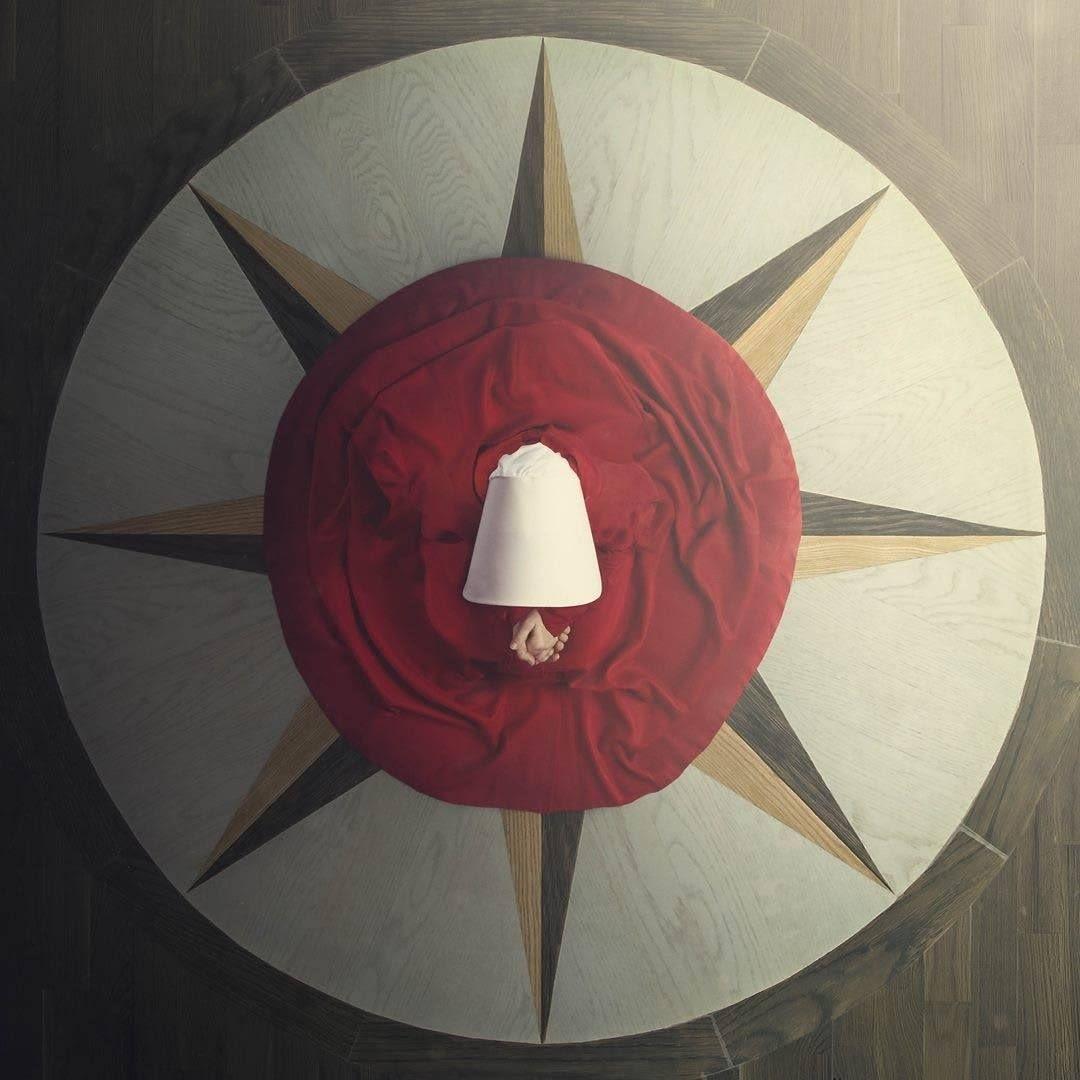
In Margaret Atwood's The Handmaid's Tale, fertile women are forced into reproductive servitude by the Republic of Gilead, a theocratic totalitarian regime that overthrew the United States of America. The women of Gilead are subject to intense physical, social, and panoptic surveillance, which relies on human monitoring rather than technological infrastructure. The various aspects of the Gileadean government that enforce the strict social hierarchy seen in the novel reflect the Panopticon discussed in Michel Foucault's Discipline and Punish. While figures like the "Guardians of the Faith" act as visible instruments of the republic's power in their roles as security, drivers, and soldiers, the "Eyes of God" represent a panoptic power: secret police who act as spies for the regime. Obedience is enforced in the novel through social surveillance and through the Aunts, a sect of women who oversee the indoctrination and punishment of disobedient Handmaids. Religion in this novel acts as the ultimate Panopticon, a power that is visible in the governmental structure and religious symbology of Gilead, and unverifiable in the Eyes and their reliance on human rather than technological surveillance.
In Discipline and Punish, Michel Foucault analyses Jeremy Bentham's Panopticon, a circular prison designed so that a single guard in a central tower can observe all inmates at any time, while the inmates cannot determine whether they are being watched. Foucault's crucial argument is that the Panopticon's power does not rely on constant observation, but on the possibility of it: "he is seen, but he does not see; he is the object of information, never a subject in communication" (Foucault 200). Over time, the watched subject internalizes the gaze and begins to regulate their own behaviour, making the actual presence of a guard unnecessary. Foucault argues that this logic of surveillance extends far beyond prisons into schools, hospitals, and entire societies, functioning wherever power seeks to normalize and control populations without resorting to direct physical force. It is this distributed, internalized, and self-perpetuating model that Atwood reconstructs in Gilead, replacing Bentham's architectural tower with the omnipresent, unverifiable eye of a theocratic God.
As a theocracy, the Republic of Gilead relies heavily on religious symbology throughout its governmental structure and ritual practices. The government is entirely patriarchal: Gilead is run by committees of Commanders, who lead each household and dictate the laws of the theocracy. These laws are enforced by the Eyes, a secret police force embedded throughout Gilead in roles such as the Guardians. Unlike the Guardians, Angels serve on the front lines and are second in the hierarchy only to the Commanders. By placing themselves above the Angels in their invented hierarchy, the Commanders reveal their lust for power, writing themselves into the position closest to God. By using biblical precedent to write their laws and contrive their punishments for disobedience, the Commanders use God and the idea of His presence in Gilead as the origin and destination of its inhabitants' strife. In a scene where the Handmaids are confessing their sins at the Red Centre, Janine confesses she had been gang-raped at fourteen. Aunt Helena asks the rest of the Handmaids, "Why did God allow such a terrible thing to happen?" They reply: "Teach her a lesson. Teach her a lesson. Teach her a lesson" (Atwood 72). This scene shows that the indoctrination of the Handmaids is entirely based on the judgement and punishment of God, and ignores the actual violence of male actions, a theme not only present in Gilead but interwoven into its laws and practices.
What makes this religious framework particularly effective as a panoptic tool is not just its presence in Gilead's laws, but the way Atwood shows it to be a conscious distortion of its source material. Dorota Filipczak argues that the Bible in Atwood's novel functions as a "trapped text turned into a lethal instrument" (Filipczak 172), locked away from those it governs and selectively referenced to create oppressive laws. Even the name of the state reflects this calculated manipulation of religious history: the biblical Gilead was a territory associated with conquest, surveillance, and the presence of enslaved people, a set of associations Atwood embeds in the structure of her novel as deliberate evidence of the regime's aims (Filipczak 172). This extends to the Eyes themselves. Their official slogan, "The Eyes of God run all over the earth," distorts 2 Chronicles 16:9, in which God watches over the faithful: "For the eyes of the Lord run to and fro throughout the whole earth, to shew himself strong in the behalf of them whose heart is perfect toward him." Where the biblical source frames divine surveillance as protective, Gilead inverts it into a tool of terror and forced compliance. The Commanders do not simply borrow from the Bible; they corrupt it, stripping the text of its original meaning and replacing that meaning with ideology that serves their power.
The concept of the Handmaids themselves is also derived from biblical precedent: "And she said, Behold my maid Bilhah, go in unto her; and she shall bear upon my knees, that I may also have children by her" (Genesis 30:3). This line from Genesis acts as the justification for the reproductive servitude imposed on the Handmaids, a service deemed necessary in the novel's dystopian setting, where fertility in America plummets for reasons "not entirely clear to us" (Atwood 304). The governmental structure and practices of Gilead are entirely built around religious dogma meant to reinstitute a patriarchal society that profits from the exploitation of women. Religion in the novel therefore acts as Gilead's ultimate Panopticon, an unverifiable power that at once observes, judges, and punishes the women in the novel.
The guards of this biblically produced tower are the Eyes of God, the aptly named spies of the high-ranking Commanders, whose very name ties the regime's authority to God's. The Eyes are embedded throughout Gilead's power structure, often posing as Guardians and drivers for the Commanders (Atwood 20). Their presence is sparse throughout the novel but often discussed by Offred and other characters. In one of her first interactions with Nick, her Commander's driver, Offred remarks: "Perhaps it was a test, to see what I would do. Perhaps he is an Eye" (Atwood 18). Her inability to tell whether he is an Eye shows the panoptic power of the Gileadean structure; she cannot know whether he is a spy, and so must align her behaviour with the rules set in place by the structure to avoid punishment. The Eyes represent not just a hypothetical threat but a literal one as well: "Two Eyes, in grey suits, leap from the opening double doors at the back. They grab a man who is walking along, a man with a briefcase, an ordinary-looking man, slam him back against the black side of the van" (Atwood 169). Punishment in Gilead is swift and public, as this passage shows. After Offred witnesses the arrest, she feels relief: "It wasn't me" (Atwood 170). Gilead also uses public executions, the "Salvagings" and "Particicutions", to punish enemies of the regime. These executions are theatrical, collective, and designed to mark the body as the site of the state's authority. Yet their deeper purpose is psychological: by forcing the Handmaids to witness and even participate in executions, Gilead recruits them as agents of their own conditioning.
Central to Gilead's panoptic structure are the Aunts, a class of women granted limited authority in exchange for enforcing the regime's rules on other women. Figures like Aunt Lydia represent the most immediate layer of surveillance in Gilead, embedded directly within the Red Centre where Handmaids are indoctrinated and punished. What makes the Aunts significant in Foucault's terms is that they represent the internalization of the panoptic gaze made institutional: women who have so thoroughly absorbed Gilead's ideology that they become its most effective enforcers. Foucault argues that disciplinary power becomes most efficient when subjects not only regulate themselves but actively participate in regulating others, and that surveillance functions best when it is "permanent in its effects, even if it is discontinuous in its action" (Foucault 201). The Aunts embody this permanence because they are present during the Handmaids' formation, instilling self-surveillance before Handmaids even enter their postings. Their use of cattle prods and the "Testifying" sessions, in which Handmaids condemn each other's past behaviour, transform fellow women into tools of the regime's power. By making women the primary monitors of women, Gilead ensures that its Panopticon functions even in spaces where male authority figures are structurally absent.
In Gilead, the behaviour of Handmaids is also regulated by each other: "We aren't allowed to go there except in twos. This is supposed to be for our protection, though the notion is absurd: we are well protected already. The truth is that she is my spy, as I am hers" (Atwood 19). Among the Handmaids are true believers, women who embrace their reproductive servitude, "a Handmaid in more than name" (Atwood 19). The presence of these indoctrinated Handmaids makes it difficult for Offred to discern who is safe to conspire with and who is not, reflecting the unverifiable nature of the Panopticon even in daily interactions. This conformist mentality is emphasized by the robes each class of women is required to wear. Handmaids are dressed in red, a colour that, according to the historical notes in the novel, was borrowed from the uniforms of German prisoners of war in Canadian "P.O.W." camps (Atwood 307). Practically, the colour red makes the Handmaids easy to spot, functioning like the bright lights of the Panopticon that illuminate the actions of its prisoners.
The other castes of women in Gilead are similarly clothed, each assigned a different colour that denotes their status. Where there exists a social hierarchy for the men of Gilead, with the Commanders at the top and the Guardians at the bottom, so too there exists a social hierarchy for the women of Gilead, which sits directly beneath the men's. The highest class of women, the Wives, are still afforded less autonomy and respect than the lowest of the male castes. With the exception of the Aunts, women in Gilead are prohibited from reading and writing, a form of epistemic control that reinforces Gilead's panoptic structure. For Foucault, the power to watch and the power to know are inseparable: those who are surveilled are deliberately kept from understanding the system that surveils them. In one scene, the Commander reads aloud from the Bible to a household that, with the exception of Nick, is forbidden from reading. When Offred reflects that the Bible is "an incendiary device: who knows what we'd make of it, if we ever got our hands on it?" (Atwood 87), she identifies precisely what Gilead understands about literacy: that the ability to read is the ability to interpret authority, and interpretation threatens obedience. By restricting women to orality, Gilead ensures that the rules of the Panopticon can never be fully understood by those most subject to it, sustaining the unverifiability of power that Foucault identifies as essential to its function.
Offred encounters an embroidered cushion with the word "faith" on it: "I can spend minutes, tens of minutes, running my eyes over the print: FAITH. It's the only thing they've given me to read. If I were caught doing it, would it count?" (Atwood 57). This line shows the irony of Gilead's structure: the women subject to its rules are not even allowed to read them. Atwood describes how instrumental this kind of enforced silence is to power in her 1981 address to Amnesty International, four years before the novel was published: "the aim of all such suppression is to silence the voice, abolish the word, so that the only voices and words left are those of the ones in power" (Atwood, "Amnesty International"). This can be applied to the oppression of all the women in Gilead, not just the Handmaids but the Wives, Marthas, Econowives, Jezebels, Unwomen, Aunts, and Daughters who suffer under the patriarchal rule of the Commanders. Mario Klarer argues that this forced return to an oral culture is most apparent in the medium of the novel itself, which the historical notes reveal to be a transcription of audio recordings. He writes that "oral traditions develop a tendency to support existing systems and have a conservative effect, whereas literate cultures have destabilizing and innovative potential" (Klarer 2). This helps explain why a totalitarian regime would want its subjects unable to read.
The panoptic function of this enforced orality becomes clear when read through Foucault's model of disciplinary power. By denying women literacy, the regime ensures that women cannot access, interpret, or contest the laws they are subject to, and also that no written record of Gilead's crimes can be produced by its victims. This may also explain why Gilead relies on human monitors rather than the surveillance technology available to it: human testimony is deniable, and evidence is suppressible. For Foucault, the goal of surveillance is not documentation but normalization, the production of subjects who regulate themselves. Gilead achieves this through its enforced orality: women who cannot write cannot organize, theorize, or remember collectively in ways that threaten the regime. Atwood's choice to frame Offred's narrative as a transcription of cassette tapes, a merging of oral and written form, is therefore a deliberate act of subversion: it restores to Offred the documentary power that Gilead worked to deny her.
Gilead's most effective instruments of control are not its soldiers or its executions, but the structures of observation and self-enforcement that Foucault identifies as the defining features of the disciplinary Panopticon. The Eyes stand in for Bentham's unseen guard; the mandatory uniforms of each caste of women illuminate their wearers the way floodlights illuminate a prison yard; and the Aunts, the Handmaid pairs, and the indoctrinated true believers ensure that even when no official guard is present, the women of Gilead watch each other. Most critically, Gilead replaces the Panopticon's tower with God, an observer who is by definition omnipresent, omniscient, and unverifiable, the perfect ideological instrument for a regime that wants its subjects not merely controlled, but believing they deserve to be. What The Handmaid's Tale ultimately argues is that a Panopticon built on religion and shame is more total than any prison, because its walls exist entirely in the minds of those it confines.
Bibliography
Atwood, Margaret. The Handmaid's Tale. Toronto: McClelland and Stewart, 1985.
Atwood, Margaret. "Amnesty International: An Address." In Second Words: Selected Critical Prose. Toronto: Anansi, 1982.
Filipczak, Dorota. "Is There No Balm in Gilead? Biblical Intertext in The Handmaid's Tale." Literature and Theology 7, no. 2 (1993): 171–185.
Foucault, Michel. Discipline and Punish: The Birth of the Prison. Translated by Alan Sheridan. New York: Vintage, 1995.
Klarer, Mario. "Orality and Literacy as Gender-Supporting Structures in Margaret Atwood's The Handmaid's Tale." Mosaic 28, no. 4 (1995): 129–142.
The Holy Bible, King James Version.
Read next, in Literature
- Cædmon's Chronicle Alexander Birch
- The Ruin Aneirin Sprake-Harris
- Sir Ian McKellen and “The Strangers’ Case” Edward Clark