

Philosophy · Essay · From the archive
The Eudaimonist Reconciliation of Pragmatic and Ideal in Plato and Aristotle
Thrasymachus argued that injustice pays. Plato and Aristotle answered him, and Aristotle answered him better.
Max John Antoni Juszkiewicz · Durham University · 18 September 2026
Durham University · 18 September 2026
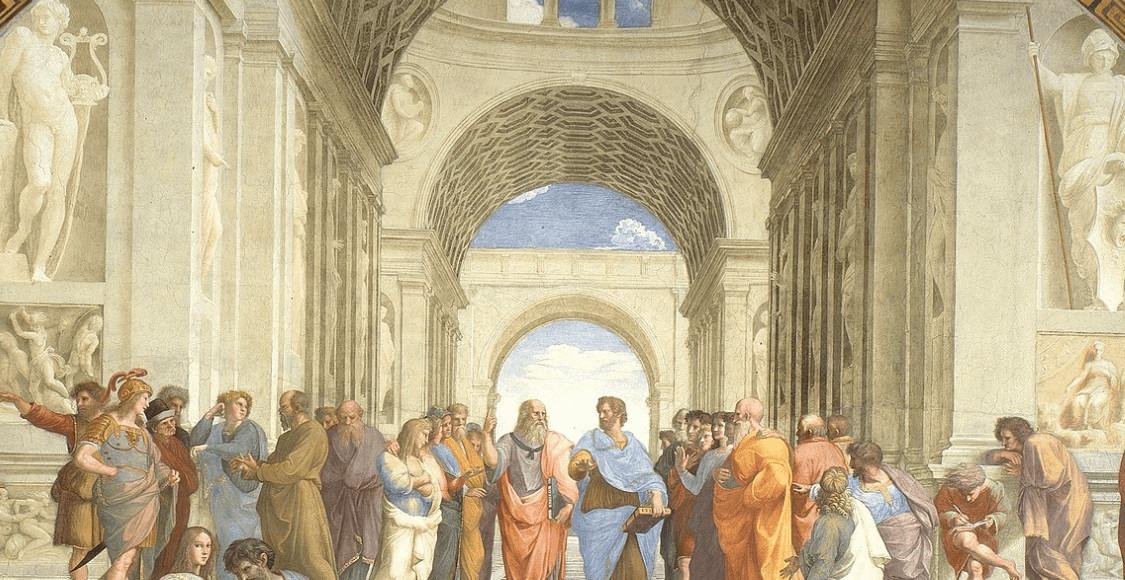
This essay will argue that the Eudaimonist approach developed by Plato (in: Plato, Phaedo, Protagoras, Republic), and later reframed in Aristotle’s own investigations (Aristotle, Eudemian Ethics, Nicomachean Ethics, Politics) successfully reconciles the “practical” and the “ideal” (hereon; the “reconciliation”) by showing virtuous character to be a core element in a life of Eudaimonia (happiness/flourishing). I begin by addressing the motivation for this kind of Eudaimonist argument, targeting Plato’s response to assaults on the traditional conception of justice; perhaps his core virtue, and that of the Greek World generally (Havelock, 1978, p. 1), by his interlocutors, and focus on the desire to provide a practical reason for acting justly. I will then attempt to demonstrate the success of Plato’s Eudaimonist perspective at establishing the reconciliation, and the developments made upon it by Aristotle. The essay will conclude that both approaches provide successful refutations of the initial arguments of Plato’s interlocutors.
There is an implication in Plato - in the thought of Thrasymachus, Glaucon, Adeimantus, and Protagoras - of the existence of a kind of relativist approach to justice (Plato, Protagoras, Republic). For Protagoras, justice is relative to the laws (Plato, Protagoras 320d-328d; Kamtekar, 2014, p. 374), for Thrasymachus, those laws are relative to the ruler, and in their interest (Plato, Republic 338b-339b). For Glaucon, and Adeimantus justice is contractual (a kind of Hobbesian compact) (Plato, Republic 358a-359b; Schofield, 2000, p. 205; Hobbes, 2018; Horky, 2020, pp. 268-269). This “value-neutral” conception of justice is what allows for Thrasymachus to argue that injustice is practically better than justice (Plato, Republic, 348b-348e).
Plato sets implicitly against this the following traditional conception: justice has value in itself, and one should perform just acts not for gain, but simply because they are just. This is embodied by the character of Cephalus, and his “external” approach to justice - doing the right things, and following the right rules (Plato, Republic 328c-331e; Annas, 1981, pp. 18-34). Plato perceives that people like Cephalus do “not care… much” about morality (Annas, 1981, p. 20), at least about understanding it - and that understanding of reasons matters (Annas, 2015, p. 64). Annas proposes that this “standard” view of justice can be opposed by the “oddballs” above because the ordinary person of Plato’s time is unaware of a strong argument for justice; beyond “the lawgiver” or “tradition” (Annas, 2015, pp. 61-64). While I agree generally, I offer one caveat: tradition might provide a firmer justification (for acting justly) than Annas suggests if the gods are still genuinely believed to intervene in cases of injustice. Regardless; the implication of Plato’s desire to refute Thrasymachus’ argument - rather than dismiss him out of hand - is that the traditional conception does not, for him, successfully establish both an intrinsic (personal), and moral good of justice.
There seems to be something central enough about the desire for moral good to be itself “useful” (for oneself) that any challenge to the above “relativist” justice must include an argument for this (Kamtekar, 2014, p. 374; Annas, 2015, pp. 53-56). Perhaps an element of “usefulness” is necessary for virtue to be convincingly defended in the period. Where the traditional argument for virtue is “if wrong is done, the wrongdoer will receive punishment (from the Gods)” - the idea of non-human (internal or divine) consequence for wrong action is probably expected in any argument for virtue (Hesiod, Works and Days, 238-250). For Plato, of course, Eudaimonia cannot be achieved without virtue, especially the well-ordered soul brought about by justice (Plato, Republic 357d-358b; Annas, 2015, p. 49).
Plato’s challenge in the Republic, then, is to find a strong defence of the good of justice both for the individual (for example; Kraut, 2006, p. 312; justice is fundamentally “in one’s interest”), and morally. Plato’s eudaimonism is therefore a reconciliation of “practical” and “ideal”. This reconciliation is approached again by Aristotle from a different perspective (discussed later). With this groundwork established, I will now argue for the effectiveness of Plato’s defence of justice (and virtue) with regard to the reconciliation specifically.
The objection of Sachs (1963) to Plato’s justice is important, as it ultimately threatens to undermine the conclusion that Plato succeeds in his reconciliation. Sachs argues that Plato cannot prove that a state of “vulgar” justice in the individual (that is; justice by abstention from unjust acts, or traditional morality) is always reached by “Platonic” justice (that is, briefly, justice as the well ordered soul), even if Plato believes that it usually will be (Sachs, 1963).
Ultimately, however, this distinction is not damning to the argument advanced here; though I will not challenge the notion that Plato’s justice represents a departure from “traditional morality”. Rather, Platonic justice in the individual is so formed by Plato because he believes that such internal inclinations of good-order place a person in the best position to judge which actions are good - not simply follow an acquired moral code. Annas suggests this when she notes the importance of reasons for Plato (Annas, 2015, p. 64). Plato’s goal is not an abstract morality, but the capacity to aim at the good (the Form thereof, and Eudaimonia generally), and the importance of justice (and virtue) as part of this (Kraut, 2006, p. 320; Annas, 2015, p. 63).
I believe, therefore, that Sachs (1963) is correct in differentiating kinds of justice, but that for the sake of this discussion, a “tendency” of the Platonically just man to act according to the rules of traditional morality maintains the reconciliation. First; because the ideal for Plato is not traditional morality (Annas, 2015), rather his own conception of the ultimate good (Plato’s justice is necessary for the functioning of a perfect state, and a good individual, even if it does not always take the form of actions associated with “traditional” morality - I follow, here, roughly the argument of Demos, 1964, so I will not restate it in full), and Second; because even if traditional morality is taken as an aim, Plato succeeds in providing a better internal motivation (read; practical reason - virtue bringing the soul health and flourishing, the alternative; sickness and disorder) for acting morally than - for example - the poets’ divine retribution. (Hesiod, Works and Days, 238-250; Homer, Iliad 1.7-32; Plato, Republic 444c-444e; Havelock, 1978 pp. 5-8)
Furthermore, while Williams (1999), and Sachs (1963) challenge the microcosm-macrocosm analogy (because, in the former case, of logical flaws in the parallel parts of soul and city, and in the latter, because of an apparent failure to demonstrate that justice in the soul would result in vulgar justice, i.e. moral action - addressed above), I still contest that the attempt to make this bridge in scale is significant (Plato, Republic 368e). It is true that, when dissected, the logic of Plato’s argument meets with pitfalls. For example; a city of (Platonically) “democratic men” hardly meets Plato’s description of a “democratic city” (Williams, 1999, p. 260). Despite the flaws, I believe Plato is touching on something significant for the reconciliation when he shows that a communal good (justice) is also good for the individual. In order to accept the argument made here, one does not have to believe that every virtue in the city exactly corresponds to a virtue in the individual, only that virtue in the individual is good for the city, and vice versa - the “ideal” of moral good in the community is closely linked to the “practical” good (Eudaimonia) that virtue brings to the individual.
Plato’s argument is strong because it takes into account the underlying motivation of his interlocutors (individual benefit), without conceding the value of justice as a moral good, and it links individual flourishing with justice in the community - an idea advanced later by Aristotle.
I now address Aristotle’s contributions. I will avoid discussion of whether he can be considered a Platonist (Gerson, 2005), it is enough, for my purposes here, to understand his philosophy as similarly aiming at Eudaimonia (Nagel, 1972, p. 252; Polansky, 2014, pp. 2-6; Bozkaya, 2024, pp. 432-434). Therefore, I will begin by establishing the view that Aristotle aims at continuing the argument of Plato for the reconciliation, before elaborating on the strengths of Aristotle’s argument.
While Aristotle is not responding directly to Plato’s interlocutors, his work retains the same desire to show that practicality and the ideal can be reconciled as Plato. Aristotle sets out, throughout Politics and Nicomachean Ethics, to prove that Eudaimonia is reached through a combination of practical wisdom, and virtue - attained through habituation, built on the inherent ethical capacity of human nature (Miller, 2000, pp. 328-330). The end goal which Plato and Aristotle seek is broadly similar; both are Eudaimonists, they value human flourishing, and both agree that the best life is that of philosophy - granted, Aristotle more tentatively than Plato, see; Nagel (1972), who provides an account of Aristotle’s “intellectual” Eudaimonia with which I broadly concur. There are, of course, differences. Notably; Plato’s Phaedo shows that he perceives the highest life to be that of philosophy, partially because it provides the best afterlife (Plato, Phaedo 82a-84c). Aristotle’s reasons are more earthly, though the best life remains the contemplative (for example; Aristotle, Eudemian Ethics, 1249b17-1249b24). While a non-exhaustive list, the above comparisons should demonstrate that both philosophers agree that individual good relies on virtue.
The crucial point of divergence - which in my view lends Aristotle a stronger defence of the reconciliation - is the following: for Aristotle, virtues cease to be ends in and of themselves, they multiply, and are each situated at a mean between two vices (for example; meanness - liberty - prodigality) rather than Plato’s pairs of opposites (Aristotle, Nicomachean Ethics 1119b-1122a; Young, 1989, p. 234). In order to achieve proper functioning, virtues must be paired with practical wisdom; these rely upon one another to exist. This conception of virtue is strong; it displays more effectively than Plato the moral and practical risks of a wide range of human vice, most significantly excesses, which display intuitively how excessive desire for pleasures, like spending money, can be counterproductive for one’s flourishing (Aristotle, Nicomachean Ethics 1119b-1122a).
The inherent cohabitation in Aristotle’s thought of the community and individual (man as “zoon politikon” - Miller, 2000, p. 326; Bozkaya, 2024, pp. 432-433) is attractive because it provides something akin to the “social contract” accounts of justice of Glaucon, while maintaining the goal of moral good. The good functioning of man is functioning in accordance with the good state (the polis) and vice versa (Miller, 2000, pp. 325-332). The parallel being: under a social contract, people pragmatically agree to justice so none are treated unjustly - because being treated unjustly outweighs the benefit of being able to do injustice (Plato, Republic 358a-359b). For Aristotle, man must exist within a good state to fully flourish, and thus he must act morally and justly to his fellow citizens, the alternative, savage independence, simply is not an option (Aristotle, Politics 1252b28-1253a7).
Aristotle has thus made the question of “pragmatism versus idealism” quite redundant. Where living virtuously in a good society is the only way to achieve the proper functioning, and vice contradicts that functioning, acting against the tenets of virtue can no longer be “practical”. Aristotle displays so attractively the interconnected nature of human happiness with virtue, wisdom, and thus society that it becomes increasingly challenging to draw apart the pragmatic and the ideal which seemed so natural in the pre-platonic world (see Thucydides, The Peloponnesian War 5.84-114; Orwin, 1984, pp. 487-489).
To conclude; I have argued that Plato and Aristotle display the ideal life to be a life of Eudaimonia, contingent on virtue (amongst other factors). By first recounting the arguments of Plato’s interlocutors, then demonstrating the ways in which the works of Plato and Aristotle overcome these challenges, I have defended the position that this kind of philosophy successfully reconciles “pragmatic” concerns with “idealism”, by showing that human beings cannot fully flourish without a virtuous character.
Bibliography
Ancient Sources:
Aristotle (2020a). Nicomachean Ethics. Translated by C. Rowe and S. Broadie. Oxford: Oxford University Press.
Aristotle (2020b). Politics. Translated by E. Barker and R.F. Stalley. Oxford: Oxford University Press.
Aristotle (2020c). The Eudemian Ethics. Translated by A. Kenny. Oxford: Oxford University Press.
Hesiod (1932). Works and Days. Translated by T.A. Sinclair. London: Macmillan.
Homer (2015). The Iliad. Translated by P. Green. Berkeley: University of California Press.
Plato (2008). Republic. Translated by R. Waterfield. Oxford: Oxford University Press.
Plato (2019a). Phaedo. Translated by D. Gallop. Oxford: Oxford University Press.
Plato (2019b). Protagoras. Translated by C.C.W. Taylor. Oxford: Oxford University Press.
Thucydides (2009). The Peloponnesian War. Translated by M. Hammond and P.J. Rhodes. Oxford: Oxford University Press.
Modern Sources:
Annas, J. (1981). An Introduction to Plato's Republic. Oxford: Oxford University Press.
Annas, J. (2015). Plato's Defence of Justice: The Wrong Kind of Reason? In: Ø. Rabbås et al., eds., The Quest for the Good Life: Ancient Philosophers on Happiness. Oxford: Oxford University Press, pp. 49–65.
Bozkaya, K. (2024). The Path to Eudaimonia: A Critical Analysis of the Relationship Between Morality and Politics in Aristotle. International Academic Social Resources Journal, 9(5), pp. 430–438.
Demos, R. (1964). A Fallacy in Plato's Republic? The Philosophical Review, 73(3), pp. 395–398.
Gerson, L.P. (2005). Aristotle and Other Platonists. Ithaca: Cornell University Press.
Havelock, E.A. (1978). The Greek Concept of Justice: From Its Shadow in Homer to Its Substance in Plato. Cambridge, MA: Harvard University Press.
Hobbes, T. (2018). Leviathan. Minneapolis: First Avenue Editions.
Horky, P.S. (2020). Anonymus Iamblichi, On Excellence (Peri Aretēs): A Lost Defense of Democracy. In: D.C. Wolfsdorf, ed., Early Greek Ethics. Oxford: Oxford University Press, pp. 262–292.
Kamtekar, R. (2014). The Relationship between Aristotle's Ethical and Political Discourses. In: R. Polansky, ed., The Cambridge Companion to Aristotle's Nicomachean Ethics. Cambridge: Cambridge University Press, pp. 370–382.
Kraut, R. (2006). The Defence of Justice in Plato's Republic. In: R. Kraut, ed., The Cambridge Companion to Plato. Cambridge: Cambridge University Press, pp. 311–337.
Miller Jr, F. (2000). Naturalism. In: C. Rowe and M. Schofield, eds., The Cambridge History of Greek and Roman Political Thought. Cambridge: Cambridge University Press, pp. 321–343.
Nagel, T. (1972). Aristotle on Eudaimonia. Phronesis, 17(3), pp. 252–259.
Orwin, C. (1984). The Just and the Advantageous in Thucydides: The Case of the Mytilenaian Debate. The American Political Science Review, 78(2), pp. 485–494.
Polansky, R. (2014). Introduction: Ethics as Practical Science. In: R. Polansky, ed., The Cambridge Companion to Aristotle's Nicomachean Ethics. Cambridge: Cambridge University Press, pp. 1–13.
Sachs, D. (1963). A Fallacy in Plato's Republic. The Philosophical Review, 72(2), pp. 141–158.
Schofield, M. (2000). Approaching the Republic. In: C. Rowe and M. Schofield, eds., The Cambridge History of Greek and Roman Political Thought. Cambridge: Cambridge University Press.
Williams, B. (1999). The Analogy of City and Soul in Plato's Republic. In: G. Fine, ed., Plato 2: Ethics, Politics, Religion, and the Soul. Oxford: Oxford University Press.
Young, C.M. (1989). Aristotle on Justice. The Southern Journal of Philosophy, 27(5), pp. 233–249.

The author
Max Juszkiewicz is a third year studying for a Combined Honours degree in Classics and Politics at University College, Durham. In 2026, he won the Global Undergraduate Awards for his work on Anonymus Iamblichi. His particular research interests are within the field of ancient philosophy, specifically early ethics and political theory.
All work by this author →Read next, in Philosophy