

Philosophy · Essay · From the archive
Jung, Bergman, and the Mask That Never Comes Off
Jung called the persona the mask we wear to meet the world, and warned against forgetting it's a mask. In an age when the audience never leaves the room, that warning is harder to follow than ever.
Esteban Werner · University of Bristol · 14 September 2026
University of Bristol · 14 September 2026
There is something strange about spending too much time around other people. The longer we are around them, the more aware we become of ourselves through them: how we sound, how we are being perceived, whether we are saying the right thing, whether we are interesting enough, funny enough, confident enough. Most of this isn't deliberate; we make small adjustments constantly without really noticing.
We speak differently depending on who is in front of us. Around some people we become louder, more animated, perhaps even more opinionated. Around others we become quieter, more careful, more restrained. We might exaggerate certain parts of ourselves and suppress others. With one group of friends we may be known as the funny one, with another as the serious one, with our family as something else entirely. Different environments seem to pull different versions of us to the surface.
There is nothing necessarily dishonest about this. In fact, it would probably be impossible to interact with other people without adapting ourselves in some way. We cannot behave identically in every situation, nor would we want to. The way we speak to a close friend is naturally different from the way we speak to a professor, a stranger, a parent, or an employer. Social life depends on our ability to recognize context and adapt. The strange part begins when these adjustments become so constant that we stop experiencing them as adjustments.
A version of ourselves that originally emerged in response to a particular environment can eventually become extremely comfortable to inhabit. If people respond positively, the process becomes even stronger. We discover, consciously or otherwise, that a certain way of behaving produces acceptance, attention, admiration, affection, or respect. We then repeat it; what begins as adaptation slowly becomes habit, and habit begins to resemble personality.
At that point, adapting ourselves to other people becomes less like something we consciously do and more like the normal state in which we exist. We begin anticipating how other people will react before they have reacted at all. We think about how something will sound, how we will come across, whether what we are about to say fits the person others understand us to be. Eventually, we do not even need someone physically in front of us for this process to happen; the audience has already made its way into our heads.
This is where Carl Jung’s idea of the persona becomes important. Jung used the word persona to describe the social face through which we interact with the outside world. The word originally referred to the mask an actor wears, and the image matters because it captures the idea's dual nature. A mask conceals something, but it also allows someone to occupy a role. It gives the actor a recognizable face through which they can interact with an audience.
The persona works similarly. It is not necessarily a lie, and it should not be understood simply as pretending to be somebody we are not. It is a socially adapted version of ourselves. It contains our manners, our behavior, the way we dress, the way we speak, and the roles we occupy. We behave differently with a professor than with a close friend, and differently with our parents than at a party. Some degree of adjustment is necessary for social life to work.
In this sense, the persona solves a problem. No person can expose the full contents of their inner life to everyone they meet. We filter ourselves because we have to; we do not tell a stranger every insecurity we possess, every intrusive thought we have ever experienced, every resentment, fantasy, or private fear. Social existence requires selection; the persona gives that selection structure; the persona can even be defined as a compromise between the person we want to be and the person we really are. Jung’s concern, therefore, was not that people have personas; everyone does. The problem begins when a person becomes so identified with their social role that they can no longer recognize it as a role. Instead of having a persona, they begin to believe that the persona represents the complete extent of who they are and what they stand for.
A clear example is someone who becomes completely absorbed in their profession. A professor who cannot stop being the professor outside the university, or someone whose entire understanding of themselves depends on their social status, reputation, position, or appearance. Their role has become the organizing principle of their identity. As long as the role remains intact, this may not even seem like a problem. They may appear confident, consistent, and successful. The difficulty becomes visible when the role is threatened or removed. If someone has spent decades understanding themselves almost entirely as a doctor, an academic, a parent, an executive, or some other socially recognized identity, retirement, failure, or other disturbing factors can become more than a practical change. It can become an identity crisis. The problem is no longer simply “I no longer have this job.” It becomes “Who am I if I am no longer this person?” And this is the aspect of the persona that interests me most.
If the persona exists primarily in relation to other people, then there should also be moments when we can exist without constantly maintaining it. There should be a distinction between the person responding to an audience's expectations and the person left with their own thoughts. I am hesitant to call this second person a completely “true self”. The phrase implies that some perfectly pure personality is hidden underneath everything else, untouched by culture or social experience, and I am not sure such a person exists. Even our most private thoughts have been influenced by other people. Our language comes from other people; Our values, humor, memories, fears, and desires develop through our relationships and experiences. We do not, nor can we, construct ourselves in isolation.
But I still think there is an important difference between the parts of ourselves that are continuously being adjusted for other people and the parts we encounter privately. There are thoughts we would never say aloud, interests we rarely share, opinions we might hesitate to express, and insecurities that don't fit the way other people understand us. There are desires that may contradict the identity we have constructed, fears that embarrass us, resentments we know are unreasonable, private ambitions we are afraid to admit, obsessions that would seem strange if spoken aloud. These things are not automatically more authentic simply because they are private. A private thought can be irrational, cruel, ridiculous, or completely meaningless. But privacy allows parts of the personality to exist without immediately having to justify themselves to another person. They can exist before we ask whether they are socially acceptable. That distinction is important to me; If the persona is constantly occupied with the question of how we exist in relation to other people, then solitude may provide one of the few circumstances in which that question temporarily becomes less important. In solitude, there is no immediate person to impress, reassure, entertain, convince, or satisfy, no room to read. There is nobody waiting for an answer, and yet I increasingly wonder how much genuine solitude modern life actually provides us.
We are extremely connected to one another. Most people live surrounded by others, whether through family, housemates, work, university, or simply the density of urban life. We spend much of our day in environments where other people perceive us and, therefore, we adapt, at least to some degree, to their presence. But physical proximity is only part of the problem; the more significant change is that physical solitude no longer necessarily means social solitude. A person can be completely alone in their bedroom while simultaneously texting several people, scrolling through hundreds of other people’s lives, watching videos, reading comments, listening to somebody speak through a podcast, or participating in an online conversation. The body may be alone, but psychologically the person can remain surrounded by other minds.
None of these technologies are inherently bad. I would not want to live without most of them myself. They have made communication easier and have given us access to people, information, and experiences that would previously have been impossible. Someone living far away from their family can speak to them instantly. People can find communities they would never have encountered geographically. Knowledge that once required access to a library can be found within seconds. The problem is not that connection itself is harmful.
What interests me is the way constant connection may have changed what it means to be alone. Once, there was a practical limit to other people's presence. If you returned home and closed the door, much of the outside world necessarily remained outside. Even if someone wanted to contact you, there were limits to how immediately they could do so. Boredom, silence, and periods of complete inactivity were harder to avoid; now the social world follows us wherever we go.
The moment there is silence, we can open our phones and immediately return to other people’s thoughts, faces, opinions, and lives. There is almost no level of boredom small enough that it cannot be interrupted. Every empty interval can be filled. And if the persona exists in response to an audience, what happens when the audience never really disappears? This does not mean that somebody looking at their phone is literally performing every second. The process is subtler than that. Even while consuming rather than producing something, we remain in contact with the social world. We compare ourselves, we encounter what other people value, how they present themselves, what they find desirable, embarrassing, attractive, or successful. We are constantly reminded of the existence of other people’s judgment, even when nobody is directly judging us. The imagined audience can therefore survive without a real one.
We may take a photograph and immediately imagine how somebody else would see it. We consider posting something and think about how it might be interpreted. We receive a message and think carefully about how quickly to respond, what tone to use, whether we seem too interested or not interested enough. Even something as simple as choosing clothes can involve an imagined observer, and therefore the social world begins to exist inside our heads. This is perhaps why simply being physically alone is not enough to escape the persona. We can be alone, and yet the performance can continue because we have learned to perceive ourselves through the imagined perception of others. This may also help explain why solitude can sometimes feel so uncomfortable; I have spoken to people who say they hate being alone. Some need almost constant company. Others immediately turn to their phones, music, television, podcasts, or endless scrolling whenever nothing is happening around them. Silence itself seems to create a discomfort that has to be filled with something.
Of course, there are many possible reasons for this. Human beings are social animals by nature; loneliness can be genuinely painful, and using a phone frequently does not mean somebody is secretly terrified of their inner life. I do not want to reduce ordinary behavior to a psychological pathology. But I am interested in the possibility that constant stimulation can sometimes serve as a way to avoid sustained contact with our own thoughts.
When nothing external is demanding our attention, the mind begins to produce its own material. Memories return, anxieties become louder. Questions that are easy to avoid during a busy day become harder to ignore. We may discover that we are unhappy with something we thought we had accepted, that we want something inconsistent with the identity we present, or simply that we do not know what we actually want when nobody else is involved. Solitude therefore does not necessarily reveal something pleasant. Perhaps this is precisely why it can be valuable. The parts of ourselves that do not fit comfortably within the persona are unlikely always to be flattering. If we encounter ourselves only through environments in which we continuously adapt to other people, then parts of the psyche that cannot easily participate in that adaptation may remain unexplored.
The issue, then, may not simply be that we use the persona too much. The persona is necessary. We cannot and probably should not attempt to live without one. The more serious problem would be losing the ability to recognize what exists outside it. And there is an even more difficult possibility. What happens if someone grows up with so little psychological solitude that they never develop a strong sense of themselves outside social perception in the first place?
This question seems particularly relevant to generations that have experienced constant connectivity since childhood. Previous generations also faced enormous pressure from family, religion, school, class, and community, so identity being shaped by others is not new. Human beings have never existed independently of social influence. What seems different today is how continuous that influence is. A child or teenager can now carry their social environment with them throughout almost every part of the day. School no longer necessarily ends when they leave the school building. Friendships, conflicts, popularity, gossip, and social comparison can continue through a screen until the moment they fall asleep. The boundaries between public and private life become much less clear.
This makes me wonder whether solitude plays some role not only in discovering an already existing inner self, but in constructing one. Perhaps individuality requires periods when thoughts can develop without immediate exposure to reaction. A private opinion can remain unfinished. An interest can be explored without asking whether it is impressive. An identity can be experimented with without announcing it. A person can contradict themselves without somebody else remembering the contradiction. Privacy gives personality room to be inconsistent, which may matter more than it initially appears.
A social identity benefits from consistency. Other people need a stable idea of who we are to interact with us. But internally, human beings are rarely perfectly consistent. We feel things we do not understand. We sometimes behave in ways that do not fit the story we tell about ourselves. Perhaps solitude is one of the places where that inconsistency can exist without immediately having to be resolved. This is why the possibility of losing psychological solitude concerns me more than the simple amount of time we spend socializing.
I do not know whether it makes sense to say that a person who has never experienced enough solitude would have “no inner self”; that is probably too absolute. But I do wonder whether a person who rarely experiences themselves without an audience may find it much harder to distinguish what they actually want from what they have learned to want, what they believe from what they have learned to say, or who they are from who they have learned to present.
They may know perfectly well how to answer the question “Who are you?” in social terms. They can describe their interests, profession, relationships, tastes, politics, ambitions and personality. But a list of socially recognizable characteristics is not necessarily the same thing as knowing oneself. The more difficult question might be what remains when those descriptions are temporarily suspended. Not what job do I have, what do my friends think of me, what do I post, what kind of person am I supposed to be, but simply: what happens inside me when none of those things are demanding an answer?
Perhaps the real danger of the persona is therefore not that it makes us fake. It is that, if we never get enough distance from it, eventually we may stop noticing that there is any distance at all. This constant, uninterrupted use of the persona and the loss of contact with our inner self may even lead to mental collapse; that is what Ingmar Bergman portrayed in his film “Persona” (1966).
Persona, directed by Ingmar Bergman, follows two women. Elisabet Vogler is a celebrated stage actress who, in the middle of a performance of Electra, suddenly stops speaking. She stands on stage in silence for a long moment; the performance continues, and afterward she seems to recover. But the following day she falls silent again, and this time she does not come back. Doctors examine her and find nothing physically wrong. She is not paralyzed, nor catatonic. Her silence seems closer to a decision, or at least a refusal. She refuses to keep speaking her lines, and not only the ones written for the stage. She stops performing as an actress, a wife, a mother, a patient. She abandons every role that requires her to compose a face and produce the expected words.
It matters that Bergman made her an actress. Acting is the persona in its most literal and most honest form, the profession in which putting on masks is openly the job. An actress knows better than anyone that a self can be assembled for an audience, that emotions can be produced on demand, that sincerity itself can be performed convincingly. Elisabet’s silence reads as the reaction of someone who has understood this too well. If every expression can be acted, then even her tenderness toward her husband, her love for her child, and even her own suffering become suspect to her. Speech itself starts to feel like theatre. Her doctor understands this perfectly and says so, in one of the film’s few moments of direct explanation: she describes Elisabet’s silence as the hopeless dream of not seeming but being, of closing the gap between the performed self and something real. Silence looks like the only position from which she cannot lie. In Jungian terms, Elisabet attempts the thing Jung says almost no one does. She does not adjust the mask or replace it with another. She puts it down completely, and the film becomes an experiment in what that actually produces.
She is sent to recover at a doctor’s seaside cottage in the care of Alma, a young nurse, and it is Alma who interests me most, because Alma is us. She arrives with her persona intact and functioning beautifully. She is cheerful, competent, professionally warm. She is engaged to be married. She describes her future to Elisabet with the confidence of someone reading out a plan already approved: she will marry, she will have children, she will keep nursing, and this, she says, is what she wants. Everything about her is consistent, socially legible, and reasonable. Early in the film, she even reflects on how comforting that consistency is, the idea that you can become one settled thing and simply be it.
But a persona is sustained by an audience that responds to it. It exists in the exchange of signals, in the small confirmations other people give us that our performance has been received and accepted. Elisabet provides none of this. She only watches and listens, with an attention that gives nothing back. And faced with that unresponding attention, Alma begins to talk. At first she talks the way anyone talks to fill a silence, about small things, about the approved version of herself. Then something starts to loosen. With no reactions to calibrate against, no smiles or frowns telling her which parts of herself are acceptable, the filter that normally operates in every conversation stops working. One evening she tells Elisabet about a sexual episode from her past, a spontaneous encounter on a beach that fits nowhere in the tidy life she has described, and about its consequences, which she has never confessed to anyone. She is shocked by how she tells it. She talks about her fiancé and realizes, almost in real time, that she is not sure she believes the future she recited so confidently. What she says in that cottage falls into the category this essay has been describing: the thoughts, desires, and contradictions that exist outside the persona and normally never survive contact with an audience.
Bergman then shows why this material usually stays hidden. Alma discovers a letter in which Elisabet describes her to the doctor with detached amusement, as an interesting case, someone whose confessions she has been studying. The one person Alma trusted with her unperformed self turns out to have been an audience after all, and a judging one. The effect on her is close to violence. Her warmth collapses into rage and cruelty; the composed nurse deliberately leaves broken glass where Elisabet will step on it and watches. The persona does not simply slip. It shatters, and what comes through is not a serene authentic self but everything the persona had been holding back, arriving all at once and unmanaged. Jung would have recognized the scene immediately: the brighter and tighter the mask, the more concentrated the shadow behind it.
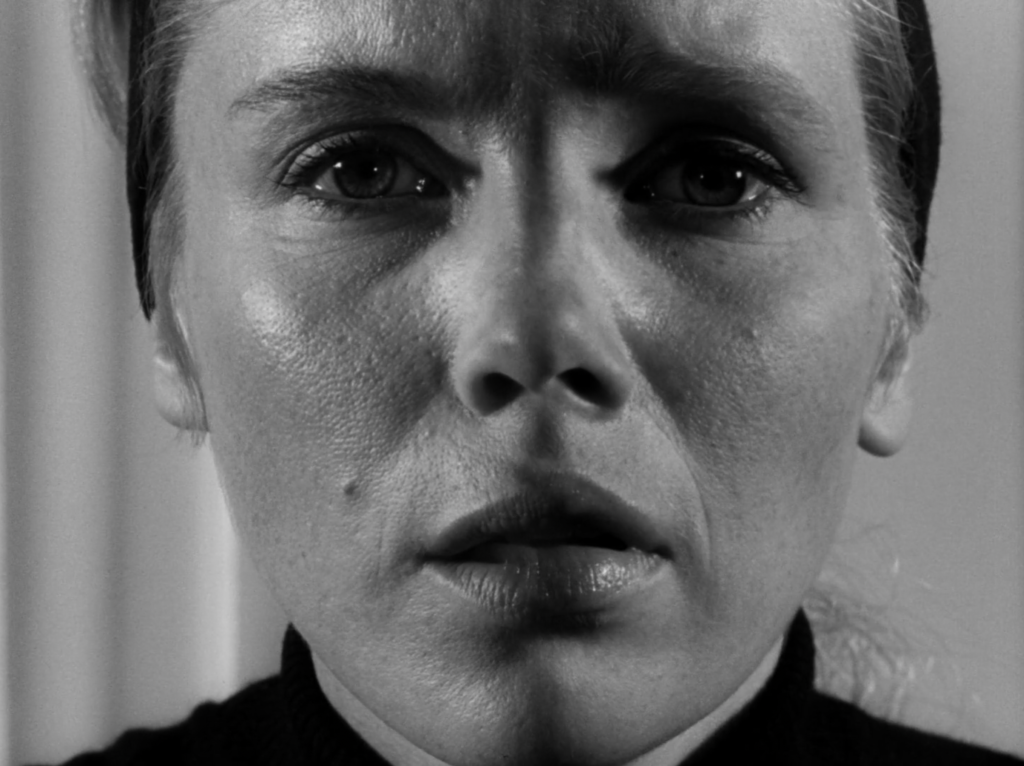
From there the film abandons realism almost entirely. The two women’s identities begin to bleed into each other. Elisabet’s husband visits and addresses Alma as his wife, and Alma, horrifyingly, answers as her. Alma delivers a long monologue about Elisabet’s failed motherhood, and Bergman shows the entire speech twice, once framed on Elisabet’s face and once on Alma’s, as if the words belong equally to both women, until it is no longer clear who is describing whom. Then comes the image the film is remembered for: the two faces joined into a single composite, half Alma, half Elisabet. It is often described as the moment the women merge, but I think it is more precise to say it is the moment the film asks its real question. If the persona is what makes each of us a distinct, recognizable, bounded person, then what exactly remains to separate two people once their personas have been stripped away?

The unsettling thing about Persona is that it refuses the comforting answer. Elisabet’s silence does not uncover a truer, purer self hidden beneath the actress. The film is very careful about this. Her refusal to perform gradually becomes a performance of its own, and arguably a crueler one, a position of power from which she can observe others exposing themselves while risking nothing. Even her withdrawal is a kind of mask. Bergman seems to share the suspicion I described earlier in this essay: that no finished, untouched, authentic person waits underneath the social self, and that anyone who tears the mask off expecting to find one will find something far less stable instead. But the film does not conclude that the mask is everything either. Alma survives. In the closing scenes, she packs up the cottage alone, puts on her nurse’s uniform, and leaves on the bus, returned to her role but visibly not the same person inside it. Whatever she is now, she can no longer mistake the uniform for herself.
Read it this way, Persona is not simply a portrait of madness, nor an argument against the persona. It studies what happens when the distance between a person and their mask is lost, in either direction. Elisabet loses it by rejecting the mask absolutely and discovering that pure, unperformed being is unavailable to her; no self exists anywhere and for no one. Alma loses it in the opposite and more ordinary way, the way this essay has been worried about all along: her persona was so comfortable, so rewarded and so continuously in use that she had never examined what it excluded, and so when it failed she met the rest of herself as a stranger, all at once, with no preparation. Bergman needed a mute woman and an isolated island to engineer that confrontation. What concerns me is that the modern situation runs the same experiment in reverse. Alma broke because she suddenly got more unwitnessed contact with herself than she could bear. We may be arranging our lives so that we never get any at all.
I do not want to end with advice. Essays about attention and technology usually finish by recommending that we delete our apps, take long walks, and rediscover boredom, and there is nothing wrong with any of that. But it treats the problem as a matter of habits, and I think the problem sits somewhere deeper than habits. It is a problem of orientation. The persona is not an accessory we occasionally overuse; it is the default position from which most of us experience our own lives, and the conditions that once forced us out of that position, the empty evenings, the silences, the closed doors that actually closed- are quietly disappearing. Nobody decided this.
Nor do I think the answer is Elisabet’s answer. Her silence is the fantasy that we could stop performing altogether and finally coincide with ourselves, and the film is honest about where that fantasy leads. No self exists nowhere and for no one. We are social creatures down to our language, and the mask is not a corruption of the personality but one of its organs. Jung never asked anyone to remove it. He asked for something more modest and, I now think, more difficult: to know it is there. To be able, at least sometimes, to feel the small gap between the face we compose and whatever it is that composes it.
That gap is what solitude protects, and it is what constant connection erodes, not dramatically but gradually, the way a habit erodes the memory of ever having chosen it. Alma needed a silent witness and an isolated cottage to discover what her persona had been excluding, and the discovery nearly destroyed her. I am not sure we should envy her the experience. But she came back from that cottage unable to mistake her uniform for herself, and that seems to me the one thing worth taking from her story. The mask did not become false. It became visible.
So the question this essay has been circling is not how to escape the persona, or how to find the true self beneath it, since neither escape nor discovery may be possible in any final sense. Knowing the mask is there requires the one condition our lives are increasingly built to eliminate: stretches of time in which nobody is perceiving us. What worries me is not that we perform; we always have. It is that the performance may never be interrupted again. Alma's mask became visible to her only because it failed, suddenly and violently, in a cottage with no one to perform for. Ours may never fail. It may simply never come off, not because it is fixed to us, but because there may soon be no moment in the day when it would occur to us to check.

Read next, in Philosophy