
Literature · Essay · The Weekly, No. 11
Conformity and Rebellion: Joyce and Bennett on Education and Identity
How A Portrait of the Artist as a Young Man and The History Boys stage the conflict between institutional authority and the self.
Hector Hallett · University of York · 6 September 2026
University of York · 6 September 2026
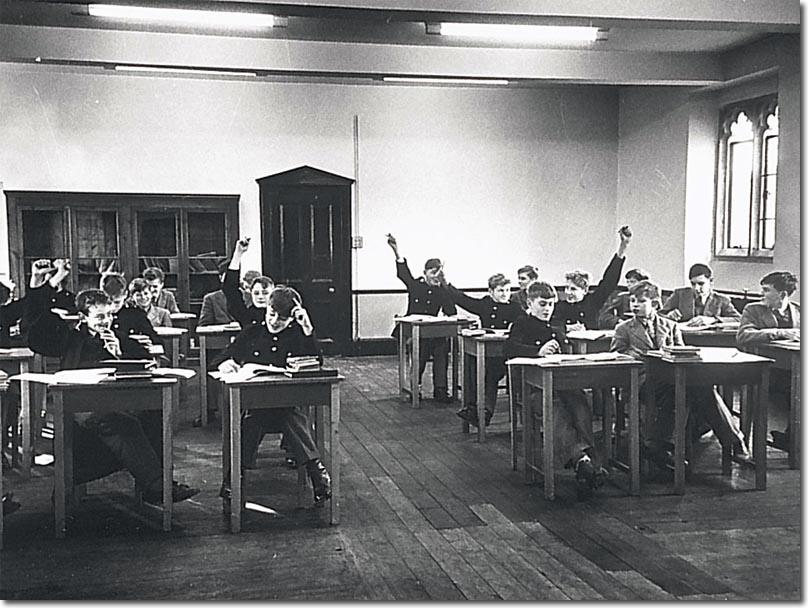
In James Joyce’s A Portrait of the Artist as a Young Man, he shows how education disciplines and destabilises Stephen Dedalus’s self-definition, leaving him with the difficult decision of whether to become a priest, enforced by Father Dolan, or to follow his newfound passion of becoming an artist. In The History Boys, Alan Bennett also stages education as an area of conflict between the Thatcherite system or individual eccentricity. Joyce’s modernist bildungsroman fluidly develops Stephen’s maturation and self-discovery over time with the use of constant stream of consciousness, perception and “everydayness”, where shifts in syntax and diction mirror his cognitive growth. Whereas in Bennett’s play, identity is not conveyed through an inner voice but rather through interaction, performance and conflict in dramatic dialogue to symbolise the performative nature of education where pupils are forced to act and conform. Joyce and Bennett both depict education as enforcing conformity, but rebellion against this authority becomes the first step towards self-definition.
Wrongfully pandied despite Father Arnell’s earlier exemption for his broken glasses, Stephen is forced to confront the instability of authority at Clongowes. The humiliation Father Dolan inflicts on him unsettles his childhood certainties, and Joyce lets the moment stand as a formative rupture in Stephen’s early moral consciousness. After this act of clerical brutality, Stephen now associates Church power with cruelty as his punishment ignores reason. In response, artistic freedom begins to appear as an alternative to the priesthood’s demand for obedience and order. To emphasise this internal tension, Joyce cleverly uses Stephen’s own name. Saint Stephen, in history, is the first Christian martyr accused of blasphemy. Therefore, Stephen's namesake acts as his own resistance to Christian authority. In this scene, Joyce employs sound patterning to mimic ritual. The repeated slap-like rhythm enacts punishment, ‘the scut the scut the scut,’ as onomatopoeic repetition shows Stephen’s inner humiliation. While this moment can be seen as Stephen’s first step to resistance, it could also be read as exposing his helplessness, suggesting that Joyce’s satirical representation of the Church operates more strongly than Stephen’s agency at this stage. Thus, Stephen’s early sense of rebellion is shown to be ambivalent, shaped as much by confusion and vulnerability as by any real challenge to authority. Jesuit schools in the late nineteenth century placed priests as moral gatekeepers, where punishment was framed as correction, yet the cultural revival pathed a route to Irish self-definition. Stephen’s ultimate choice of an artistic pursuit in life participates in a larger cultural movement to relocate authority from the priesthood to the page.
Karl Beckson argues that Joyce’s artistic creed derives from Arthur Symons’s notion of the ‘religion of art,’ a transformation of Catholic ritual into aesthetic devotion. He further notes that Symons’ narrator ‘practised a religion of the eyes,’1 seeking to ‘fix beautiful images from the flux of time,’2 which prefigures Stephen’s vow to become a ‘priest of eternal imagination’ who ‘transmutes the daily bread of experience into the radiant body of everliving life.’ Yet Beckson’s reading is limited because he treats Stephen’s aesthetic ‘priesthood’ too earnestly, overlooking the irony with which Joyce frames Stephen’s self-consecrating rhetoric. By invoking religious language to justify artistic creation, Joyce replaces the Jesuit priesthood with aesthetic priesthood which transforms rebellion into consecration. In The History Boys, Bennett shows education enforcing conformity with the headmaster’s obsession with results, no doubt a reflection of Thatcherite society which promotes discipline. His view on results, ‘A levels, A levels, A levels,’ reduces education to nothing but a statistic, furthering the utilitarian mindset instilled in the schooling system in the 1980s. Also, Bennett uses repetition as a formal device to enforce how institutional authority drills conformity into students, reminiscent of Joyce’s ‘the scut the scut the scut.’ Whilst Joyce's case is much more an apparent punishment, in The History Boys the removal of the individual is itself a punishment. As David Denby argues in his New Yorker review, the school’s emphasis on ‘mind-crushing exams’3 and exam-taking tricks presents education as a system that moulds boys to fit external expectations rather than nurturing individuality. Moreover, Irwin tells the boys to ‘find an angle’ and that ‘the wrong end of the stick is the right one.’ This preference for technique over thought hinders the boys’ capacity for self-definition, since Irwin’s method substitutes genuine intellectual autonomy with rehearsed cleverness, turning education into another mode of institutional indoctrination.
In this theatrical performance, Bennett uses comedic value to expose the more serious issue of the marketisation of learning. Yet, Irwin’s pragmatic methods may be read as necessary survival skills needed in a competitive system. Hector’s ideology can be seen as nostalgic and elitist in its reliance on cultural capital. The play works as both a lament for a lost culture of learning and a satire of Thatcherite utilitarianism, which reflects the way Bennett frames Hector’s methods as inspiring yet impractical. Both Joyce and Bennett present education as a mere disciplinary system, with Joyce showing how clerical force promotes conformity. Stephen is told that ‘obedience is the first duty of a student’, a line that crystallises the Church’s attempt to mould him into uniformity until he resists through art. In Bennett, 1980s utilitarianism reduces learning to numbers and league tables: the headmaster insists on ‘results, results’, and Irwin’s tricks are explicitly framed as tactics for the rankings. Joyce’s modernist form itself enacts rebellion against traditional educational structures. The fragmented syntax of Stephen’s consciousness, such as ‘cold slimy water’ or ‘a trembling foggy air’, breaks from classical narrative order and mimics his movement away from scholastic control. The interior monologue dissolves the Jesuit curriculum into fluid impressions, where learning becomes experiential rather than didactic. The novel’s stream of consciousness forces the reader to learn as Stephen does, through reflection and linguistic discovery. Bennett’s dramatic form, in contrast, thrives on the dynamic between performance and sincerity. Hector’s lyrical digressions, such as his recitation of ‘the best moment in reading’, force constant shifting registers, while Irwin sticks to didactic tone, repeatedly urging them to ‘go for something a bit unexpected’ in order to secure marks. This formal tension dramatises the conflict between education as play and education as product.
Bennett’s intercut scenes and overlapping dialogue foreground theatricality itself as an educational method which suggests that identity, alike performance, is learned through mimicry and response. Monika Bregović interprets Bennett’s headmaster as emblematic of the neoliberal conversion of learning into capital, observing that Thatcher-era reforms made results the currency of value and rendered Hector’s teaching unsuitable for the new economic conditions. Her analysis reinforces the utilitarian rigidity identified in the headmaster, ‘I am thinking league tables.’ The shift from moral to measurable knowledge mirrors Joyce’s critique of clerical obedience as both systems define worth through conformity.
The contrast between what is read in both texts reveals the distinction between education as self-discovery and education as conformity. Stephen reads adventurously, he ‘pored over’ The Count of Monte Cristo, Lord Byron, and the Romantic poets, all texts of rebellion, exile, and self-creation. These are not prescribed readings by the curriculum, yet acts of intellectual trespass, signalling a Bildung outside the institutional canon. Stephen, in one instance, was bullied by his classmates for admiring Byron. He stood his ground, signalling his unique identity, defined by his self-discovery outside authority. His private reading becomes a model for internal education, what Joyce later called the ‘spiritual-heroic refrigerating apparatus’ of the artist.
Mary Colum recalls how Arthur Symons’ The Symbolist Movement in Literature ‘was widely read by undergraduates in Ireland at the turn of the century,’4 and C.P. Curran remembered Joyce talking enthusiastically about Baudelaire and Verlaine around 1900. This historical detail supports Stephen’s self-directed reading as an act of rebellion, as Joyce’s own generation sought identity through aesthetic texts that defied ecclesiastical authority. Stephen’s choice of Byron and Dumas becomes a miniature revolt against clerical pedagogy. Whereas in The History Boys, the boys’ structured reading is not a revolt, but rather deliberate conformity structured around exam expectations. Canonical voices of Auden, Larkin, Kipling and Owen speak of empire and war reprocessed for Oxbridge entry. When Mrs Lintott mentions The Catcher in the Rye, Bennett gestures toward a modern bildungsroman that the boys never truly inhabit, as their education is mediated by performance rather than feeling. The difference is formal as well as thematic, Stephen reads in solitude, ‘his evenings were his own’, discovering a voice shaped through narrative absorption, whereas the History Boys perform literature collectively, reciting rather than truly experiencing it. Joyce presents self-directed reading as a viable route to authentic identity, while Bennett exposes how performative learning forecloses such possibility for his characters. Both texts therefore stage a tension between institutional conformity and the imagined alternatives that might allow students to develop a self beyond the systems that constrain them.
For Stephen, self-definition comes through an imaginative redefinition of priesthood, ‘a priest of eternal imagination.’ Joyce aligns this choice with mythic allusion related to Stephen’s last name. Daedalus, father of Icarus, symbolises artistic flight and danger of overreaching. This modernist rejection of religious and national ‘nets’ presents an authentic identity that is learnt over time. Stephen’s aesthetic theories later in the book turn education into an act of self-definition through myth and literature. Whereas Bennett presents a parallel alternative model through Hector, whose love of the poetic and lyrical digressions offers a cultural root into education rather than exam practice. He claims that knowledge is only valuable ‘for itself,’ this directly opposes Irwin’s pragmatic advice for Oxbridge entry. Bennett composes this tension theatrically by contrasting Hector’s eccentric speeches with clipped stage directions that dominate Irwin’s lessons, such as ‘bell rings,’ ‘Irwin writes on the board,’ or ‘the boys obediently take notes.’ embodying the battle of instrumentalism versus humanism. But these models may both be flawed. Stephen’s artistic vocation and Hector’s passion could be dismissed as unfit for the demands of a modern system. In both texts, authentic education is imagined as reaching beyond institutional authority by engaging in creativity and cultural enrichment. Yet both texts illuminate the fragility of these learning methods. Stephen’s flight risks Icarus’s fall and Hector’s humanism is undermined by his personal scandal. Both authors suggest authentic education comes with uncertainty and the need for personal choice of the students to engage with it.
The fragility might be read pessimistically, as it could be suggested there is no secure path to authentic education, as it implies risk itself is integral to forming a meaningful identity. Joyce’s Portrait functions as a Künstlerroman, where education culminates in artistic separation. Stephen’s rebellion is against the forms in which knowledge is institutionalised. His story rewrites the traditional bildungsroman by denying closure as his education leads to exile. By contrast, Bennett subverts the Künstlerroman form by refusing to allow any of his students a complete self-definition. Their learning occurs within systemic boundaries as the boys cannot transcend the exam framework in which they are trapped. In the end, Bennett’s pupils remain tethered to performance, their rebellion merely cyclical within the confines of an education system that reproduces itself.
Hector’s sentimental ‘pass the parcel’ approach, though idealistic, proves ineffectual against the pragmatic demands of the curriculum, Rudge’s comical ‘History is just one fucking thing after another’, truly reveals the futility of education when confined to repetition rather than transformation. The ultimate rebellion in both texts is the assertion of voice. Joyce privileges an inward, artistic voice, while Bennett depicts identity as a social performance. In A Portrait of the Artist as a Young Man, Joyce includes Stephen’s diary entries at the novel’s close to dramatise his emerging independence, his ‘Welcome, O life! … forge in the smithy of my soul the uncreated conscience of my race’ asserting both destiny and risk. The fragmented diary style and absence of authorial reassurance leave Stephen’s fate suspended between triumph and fall. This mirrors Joyce’s own exile from Ireland, positioning Stephen, the artist, as a cultural rebel who must embrace spiritual homelessness as the price of emancipation. In contrast, Bennett presents identity not as inward vocation but as social performance. The boys’ recitations and dramatic dialogue emphasise performance as the medium through which individuality emerges. For example, Posner’s confessions and Irwin’s concealed sexuality all testify to identity as something staged. Bennett’s meta-theatrical techniques highlight this performativity while also satirising how Thatcherite schooling reduces pupils to grades, leaving rebellion possible only in performance against authority. Thus, while Joyce suspends rebellion in mythic uncertainty, Bennett locates it in perpetual performance.
Both texts ultimately interrogate the paradox at the heart of education, that being it simultaneously forms and confines the individual. Joyce’s modernist fragmentation mirrors the liberating uncertainty of an intellectual rebellion, where selfhood is discovered through language’s instability. Bennett’s postmodern theatricality, conversely, exposes identity as performance and education as repetition rather than revelation. Both authors end with a degree of ambiguity, while A Portrait closes with Stephen’s diary and no clear resolution of his artistic future, The History Boys concludes with factual closure about the boys’ lives but thematic uncertainty over the lasting value of Hector’s ‘pass the parcel’ teaching. In doing so, Joyce and Bennett turn education into art itself, into an ongoing rehearsal of the self, where rebellion is both necessary and incomplete.
Bibliography
Beckson, Karl. “Symons’ ‘A Prelude to Life,’ Joyce’s ‘A Portrait,’ and the Religion of Art.” James Joyce Quarterly 15, no. 3 (1978): 222–28. http://www.jstor.org/stable/25476134.
Hibbert, Jeffrey. “Joyce’s Loss of Faith.” Journal of Modern Literature 34, no. 2 (2011): 196–203. https://doi.org/10.2979/jmodelite.34.2.196.
Bregović, Monika. “The History Boys on Contemporary Education.” [sic]–A Journal of Literature, Culture and Literary Translation, no. 1 (Year 4, December 2013): n.p. doi:10.15291/sic/1.4.lc.6. https://www.sic-journal.org/Article/Index/234#
Denby, David. “Liberal Education.” The New Yorker, November 27, 2006. https://www.newyorker.com/magazine/2006/11/27/liberal-education

The author
Founder and editor-in-chief of The Astyanax, which he started in 2026 to give emerging writers in the humanities a serious place to publish. He reads English at the University of York, where his interests are Modernism and its classical inheritance.
All work by this author →Read next, in Literature
- The Battle of Orphir: An Elegy Anthony J Kleem
- The Other Lion: Aslan, the Incarnation and "Us Lions" R.C. Horton
- Under His Eye: Surveillance, Religion, and Control in The Handmaid's Tale Evan Rogers