
Classics · Essay · From the archive
Blood and Fire: Troy in Heavy Metal
Metal has spent forty years plundering the Iliad for battle rage and glory. Listen to Blind Guardian's Cassandra, though, and the epic starts telling a different story.
Vlada Kampane · University of Liverpool · 16 September 2026
University of Liverpool · 16 September 2026
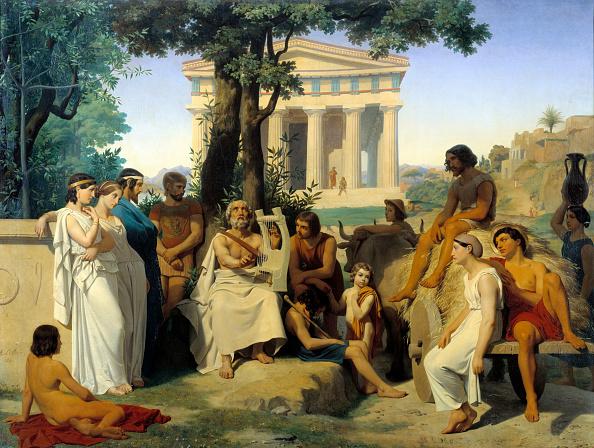
Greek mythology and epic poetry regarding Troy have been long engraved in modern popular culture, leading to a welcome revival of interest in classical works like the Iliad (Campbell, 2009, p. 111). This is evident through films like Petersen's 'Troy' in 2004, books like Madeline Miller's 'The Song of Achilles', and by examining how it inspired various songs, allowing the tales to be "disseminated" in a new light (Campbell, 2009, p. 111).
In this piece, I will focus on the reception of classical works pertaining to Troy in metal music and the extent to which it focuses on men's great deeds. For ease, I will use the general grouping of "Troy tales" or similar phrasing to refer to the epic cycle and other works focusing on the Trojan war and the events surrounding it, though I will primarily focus on the Iliad. I will examine how the reception of Troy in metal focuses on transgression and escapism; masculinity as a whole; the women of Trojan myths; and finally on men's great deeds.
Transgress and escape
Metal thrives on "escapism, empowerment and transgression" (Vaquerizo, 2020, p. 53). This is emulated through the very sound of metal, the music itself, temporarily evoking emotions like "anger, aggression, […] sadness, fear […]" (Vaquerizo, 2020, p. 53) and more, things commonly ignored as taboos due to how uncomfortable they can be to work through on a personal level. The intent seems to be a violent catharsis of sorts, a cleansing of the aforementioned emotions by attacking them directly. But how does Troy fit into this?
Metal rejects the norm, criticising the present and crafting a sense of "nostalgia for a better time" (Vaquerizo, 2020, p. 61). One way of achieving this is by using classical texts like the Iliad, traditionally considered to be part of an elitist study (Campbell, 2009, p. 113), and "corrupting" them so they become a personal portal into another world and time, which fits the transgressive nature of metal: taking something sometimes considered "above" the "common" person and reclaiming it. This is sometimes done in shocking ways which do indeed focus on men's great deeds. The song 'Achilles' Revenge' by Warlord is a prime example of this, focusing on the great deeds of the masculine hero Achilles, with lyrics describing him in Homeric terms as a "mighty" warrior who "sought the glory of war" (Vaquerizo, 2020, p. 65). The lyrics, however, also focus on violence, on how Achilles "bought the blood of his enemies, with his sword". This is seemingly an attempt to shock, emphasising the gore and brutality of war in ways that intentionally disturb some people whilst still highlighting the glorified heroics of epic poetry and the past. It may be an attempt to escape into this mythical past whilst utilising its darkness to break from the "peaceful" norm of the modern day.
The transgressive nature of metal has often been subjected to controversy related to its effects on adolescents (Vaquerizo, 2020, p. 54), something the genre apparently encourages. The "satanic panic" of the 1980s and 1990s is a key example, with many members of the public believing that certain board games, films and metal music in particular were being used to indoctrinate the youth into satanic cults practising human sacrifice and abusing children (Laycock, 2015, pp. 105–106). That is an issue beyond the scope of this essay, but it is important to keep in mind when thinking about just how fearfully and negatively the genre was viewed. Why would a genre built on dark aesthetics and an opposition to the status quo shy away from this reputation? This may be why some degree of "anti-Christianity" (Vaquerizo, 2020, p. 62) is performed, through the focus on or mere mention of foreign gods and figures linked to "Ancient Greece" and Troy, with mentions of Achilles, Zeus and more in songs across the genre, beings commonly perceived by some religious groups as hedonistic false idols. Norse mythology and satanic imagery are more common, as a distant fantasy to escape into and as a way to distance oneself from modern religious norms, but Greek mythology and epic poetry work just as well as, "to escape the banality of the modern world, it makes no difference if it is through Thor or Zeus" (Vaquerizo, 2020, p. 62).
Men's great deeds are focused on when it comes to metal and Troy, though the primary goals seem to be, through music and the appropriation of "foreign" classical Trojan tales, to desperately claw back into this mythological past whilst simultaneously shaking the foundations of all that holds the lovers of the genre back. For lack of better words, the contents of epics attract modern listeners because it is "cool" to imagine this dark yet golden era of battle and gods, and it is perceived as "creepy" or "foreign" by those the genre seeks to distance itself from.
Masculinity
There is an argument to be made that receptions of Troy in metal music focus not on men's great deeds, but on the essence of masculinity itself. To examine this, we must first establish what is meant by masculinity.
There are many who, be it by preaching with near religious frenzy that it should be a guideline, or by seeking to almost heal it with great concern, deem traditional masculinity to be the presence of attributes such as "strength, power, dominance, self-reliance, sexual virility, aggressiveness, self-control, courage, homophobia, risk-taking, honour, and stoicism" (Yarrow, 2019, pp. 62–63). Many are even taught from a young age to constantly perform these attributes, often to their own detriment, having been taught that "real men don't cry, […] don't talk about their feelings, […]" and "don't avoid a fight […]" (Yarrow, 2019, pp. 62–63). It should also be noted that masculinity and war have been intimately interlinked for a long time due to some of the expectations placed on men, listed above, and a complicated history of socialisation and other issues well beyond the scope of this essay (Ferguson, 2021, pp. 1–13). Generally however, fighting is often perceived as making one "more of a man". Though many are rightfully cautious of these specific ideals when it comes to describing masculinity, and it is indeed something that needs to be discussed, others revel in and embrace it.
On that note, some claim metal has long been what many call a "boys' club", upholding many of the long-standing stereotypes regarding masculinity noted above. In some cases, the genre is even openly hostile towards women, with bands like Manowar having lyrics like "Rape their women as they cry" in one of their songs (Vaquerizo, 2020, p. 60). The tales of Troy, for better or for worse, and the Iliad in particular, are a treasure trove of examples of this "ideal" of masculinity. This Homeric inspiration and focus on warfare, which will shortly be discussed in more detail, is something the metal genre utilises, crafting vivid images of masculine warriors, battle rage and violence in a near romanticised way (Vaquerizo, 2020, pp. 64–65). Even the sounds associated with metal, the sharpness of electric guitars, rapid beating of drums and "emotionally extreme singing techniques" from cavernous growls to sharp falsettos, bring to mind the hypermasculine atmosphere of the battlefield (Vaquerizo, 2020, p. 63).
The Iliad has numerous examples of battlefield violence, all quoted here from Peter Green's translation (Homer, The Iliad, University of California Press, 2015). We see allusions to cannibalism when Achilles wishes to "carve your (Hector's) flesh and eat it raw" (Hom. Il. 22.347), decapitation when a head is "held aloft" (Hom. Il. 14.499–500) to intimidate enemies, and other brutal deaths are listed endlessly throughout the epic. We see how metal took inspiration from these aspects of the Trojan tales and the Iliad in particular by examining the lyrical contents of various songs. 'Achilles, Agony and Ecstasy in Eight Parts' by Manowar is a strong example of this, with gory lyrics such as "Killing all in my way like sheep and like cattle", a nod to Hector storming the wall in book 12; "His bones will all be broken, dragged across the field", a nod to the grief and thirst for vengeance Achilles feels as he begins his rampage after the death of Patroclus at Hector's hands in book 16; and "Blood and fire, death and hate, your body I will desecrate, dogs and vultures eat your flesh", a nod to the dragging of Hector's corpse after Achilles kills him in book 22. The dark, violent image of a terrifying warrior seeking vengeance or victory is striking, all done by hyper-focusing on typically masculine martial themes (Campbell, 2009, p. 117).
It would thus seem that, regarding metal's reception of Troy, "men's great deeds" are a focus, but the commonly idealised violent, darker side of masculinity showcased in Iliadic heroes is what takes centre stage. This may be because this macabre masculine aesthetic, imagery of blood, death and violence, is what better suits the metal brand of sorts. It also links back to the idea of transgression and escapism mentioned above. The bloody battles, great Greek warriors and fantastical mythological history contrast directly with modern life and also repel those who dislike the darkness and violence of these specific stereotypically masculine ideals.
Women, Troy, metal
There have been steps to break through these barriers of traditional masculinity. Women became tired of the "groupie" roles pushed upon them and the violence of this boys' club, inspiring a women's movement within the metal genre, and the same goes for the world of classics, as times change and women begin to feel more able to take a stand for their place in these spaces (Vaquerizo, 2020, p. 60). The metal genre is still heavily male centred, but a clear change has taken place with more female vocalists rising to popularity.
The inclusion of female characters from the Troy tales in metal songs appropriating the myths is a strong indicator of this shift. The songs 'Under the Ice' and 'And Then There Was Silence' by Blind Guardian provide clear examples of this, focusing partly on the female character Cassandra. Lyrics like "cruelly admired" and "Enjoy your stay here, welcome to the slaughterhouse, release from rotten thoughts, no more pain, and no more gods" in 'Under the Ice' strongly allude to Cassandra's mistreatment at the hands of men like Ajax, Apollo, and Agamemnon, and are quoted and commented on in the work of Ashede and Foka (2019, pp. 106–109). This subverts what is typical for metal, focusing on a tragic feminine character rather than heroic masculine heroes. This is done in a way that still fits the genre, using darker imagery of fire, violence, slaughter and more, but this doesn't take away from the fact that when it comes to metal's reception of Troy, this is a strong shift from the typical hypermasculine heroes discussed above.
The song 'And Then There Was Silence' does something similar, with parts focusing on Cassandra's point of view. Giving a voice to Cassandra allows for a different view of the Trojan myth; it introduces more empathy and almost "takes the side of the defeated" (Vaquerizo, 2020, p. 64). There is still a focus on masculine themes of warfare and killing in lyrics like "as the lion slaughters man, I am the wolf and you're the lamb" as well as "hallowed Troy shall fall, round the wall, faith is shattered, bodies fall", leaning further into the violence and hopelessness of the Trojan myths as well as the brutality of war. Fate and the gods have already decided what will happen; all the mortals have is carnage. That said, other lyrics like "misty tales and poems lost, all the bliss and beauty will be gone […] it's the triumph of shame and disease, in the end-Iliad" also focus on the quieter fear, hopelessness and disappointment felt by Cassandra and others (Vaquerizo, 2020, p. 65). This flips the typical imagery of great, heroic, masculine victory completely.
Men's great deeds as a key focus of metal's reception of Troy seem to take a back seat, acknowledged but quietly shouted over by the voice of a woman rather than the battle cry of a male warrior. We see the focus shift in terms of character and we see a change in the perception of Troy's tale as a whole. In simple terms, the brute warrior screaming of victory and bloodshed is briefly done away with and a woman tells the tale from the perspective of one who is defeated, one who simply cannot do the same things a man has already done due to societal constraints; she must simply watch as chaos and loss reign.
"[…] he sang of men's great deeds"
In classical literature, a hero's fame (kleos andron) depends on the preservation of their great deeds in word and song which, when repeated across the ages, makes his name and kleos immortal (Vaquerizo, 2020, pp. 51, 63). This link between men's great deeds and their fame is central to the Iliad. Even heroes themselves in the Iliad take part in the spreading of these songs; Achilles, for example, "sang of men's great deeds…" (Hom. Il. 9.189–190), and it is worth noting that "men's great deeds" are specifically named as the subject of those songs. We also see heroes like Hector contemplate how their deeds and they themselves will be remembered, saying "one day […] someone not yet born may say 'this is the burial mound of a warrior long deceased […]' thus someone will speak, and my fame will never perish" (Hom. Il. 7.87–91). This is something metal highlights in relation to the Troy tales. In 'On to Iliad' by Hades, for example, the lyric "When will everybody sing your song?" leans into this idea of heroic deeds being the subject of word and song immortalising the hero (Campbell, 2009, pp. 114–116).
It must be emphasised that great deeds like the heroic journey, killing, warfare, plundering and the like have to first be carried out by the masculine hero in order for him to be worthy of songs and immortality through the songs. We see these great deeds in both the Iliad and various metal songs taking inspiration from these epic poems. Some of this has been discussed above, where I noted how the masculine violence of great heroic deeds features in the Iliad in passages pertaining to the battlefield and how metal took inspiration from these passages.
The heroic journey, the subject of the Odyssey and a major theme underpinning Greek arrival on the beaches of Troy, mentioned throughout the Iliad, is touched on by Led Zeppelin in 'Achilles Last Stand' with the lyric "sail away to sandy lands" specifically referring to this (Campbell, 2009, p. 114). Travel as part of a heroic or great deed is a common theme in many epic poems across the world; a strong example beyond the Greek tradition is the Epic of Gilgamesh, where Gilgamesh and Enkidu travel to the Cedar Forest to kill Humbaba (Sasson, 1972, p. 263). This links to the idea of a doomed warrior. We see examples of this in the Iliad as people lament the death of a warrior specifically because the warrior died "far away from his native soil" (Hom. Il. 18.99). This is something befitting the darker aesthetic of metal and its tendency to lean towards masculine ideals of fearlessness. It is heroic to travel to distant lands because the hero knows there is a chance he may not return yet does not shy away from this possibility; he does not back down.
We also see a focus on the violent plundering and sacking of cities as a major theme in the Iliad, linking again to the masculine martial themes discussed above. Achilles in the Iliad boasts of his own achievements, noting how "twelve cities of men have I laid waste with my ships […] from all I took many splendid items of treasure" (Hom. Il. 9.327–330). 'On to Iliad' by Hades also touches on this, referencing the eventual sacking of Troy in the lyric "Priam's cities see their heroes fall into your hands" (Campbell, 2009, p. 116). This boasting and the focus on these acts highlights how the heroes are proud of what they achieved. Why would they not be? After all, it adds to their honour when these deeds are recounted over and over again for centuries to come. Do we not still sing of Achilles?
Conclusion
In conclusion, regarding the reception of Troy in metal, there is a focus on pushing boundaries and fuelling escapism, there is an almost worship of masculinity and violence generally, as well as a brief shift from the heroic victor to exploring the tragic feminine characters of Troy through the voice of Cassandra. This may lead some to incorrectly believe that men's great deeds come near last in terms of what metal focuses on when looking at Troy. However, I argue that men's great deeds are in a way the only focus and flow through almost all metal songs focusing on Troy, as there would be nothing to sing of if it were not for men's great deeds in a way. Transgression is only possible because the violence and gore of men's great deeds highlighted in metal songs about Troy is so shocking to those who do not enjoy metal's aesthetic. The escapism metal adores works because Iliadic battle, a great masculine deed heroes strive for, and its links to divinity provide a striking contrast to modern life. The glorified masculine aesthetics and preferences of metal focus on violence and masculinity, but this is done through praising and focusing on men's great deeds, as mentioned above, in classical tales like the Iliad focusing on Troy. Even when women are mentioned, it is in the context of battle and other "great" deeds of men around them. Just like Achilles in book nine, people still sing of men's great deeds, for better or for worse.
Bibliography
Ashede, L. and Foka, A. (2019). Chapter 4: Cassandra's Plight: Gender, Genre, and Historical Concepts of Femininity in Gothic and Power Metal. In: K.F.B. Fletcher and O. Umurhan, eds., Classical Antiquity in Heavy Metal Music. Bloomsbury Publishing Plc, pp. 106–109.
Blind Guardian (2002). 'And Then There Was Silence'. A Night at the Opera. Virgin.
Campbell, I. (2009). Chapter 6: From Achilles to Alexander: The Classical World and the World of Metal. In: Heavy Metal Music in Britain. London: Routledge, pp. 111–122.
Ferguson, R.B. (2021). Masculinity and War. Current Anthropology, 62(S23), pp. 1–13.
Homer (2015). The Iliad. Translated by P. Green. University of California Press.
Laycock, J. (2015). Dangerous Games: What the Moral Panic over Role-Playing Games Says about Play, Religion, and Imagined Worlds. Berkeley: University of California Press, pp. 105–106.
Manowar (1992). 'Achilles, Agony and Ecstasy in Eight Parts'. The Triumph of Steel. Atlantic.
Sasson, J.M. (1972). Some Literary Motifs in the Composition of the Gilgamesh Epic. Studies in Philology, 69(3), p. 263.
Vaquerizo, H.G. (2020). Κλέα ἀνδρῶν: Classical Heroes in the Heavy Metal. In: The Hero Reloaded: The Reinvention of the Classical Hero in Contemporary Mass Media. John Benjamins Publishing Company, pp. 51–70.
Yarrow, A.L. (2019). Man Out: Men on the Sidelines of American Life. Brookings Institution Press, pp. 62–63.
The author
Final year undergraduate focusing on archaeology and classical studies.
All work by this author →Read next, in Classics