
Classics · Essay · New this week
“Money Makes the Man”: Pindar’s Poetic Persona and the Politics of the Aristocracy
Pindar’s victory odes do more than just praise their laudandus: they reinforce the very power systems that maintain the demand for his poetry.
Holly Mia Garside · University of Exeter · 6 October 2026
University of Exeter · 6 October 2026
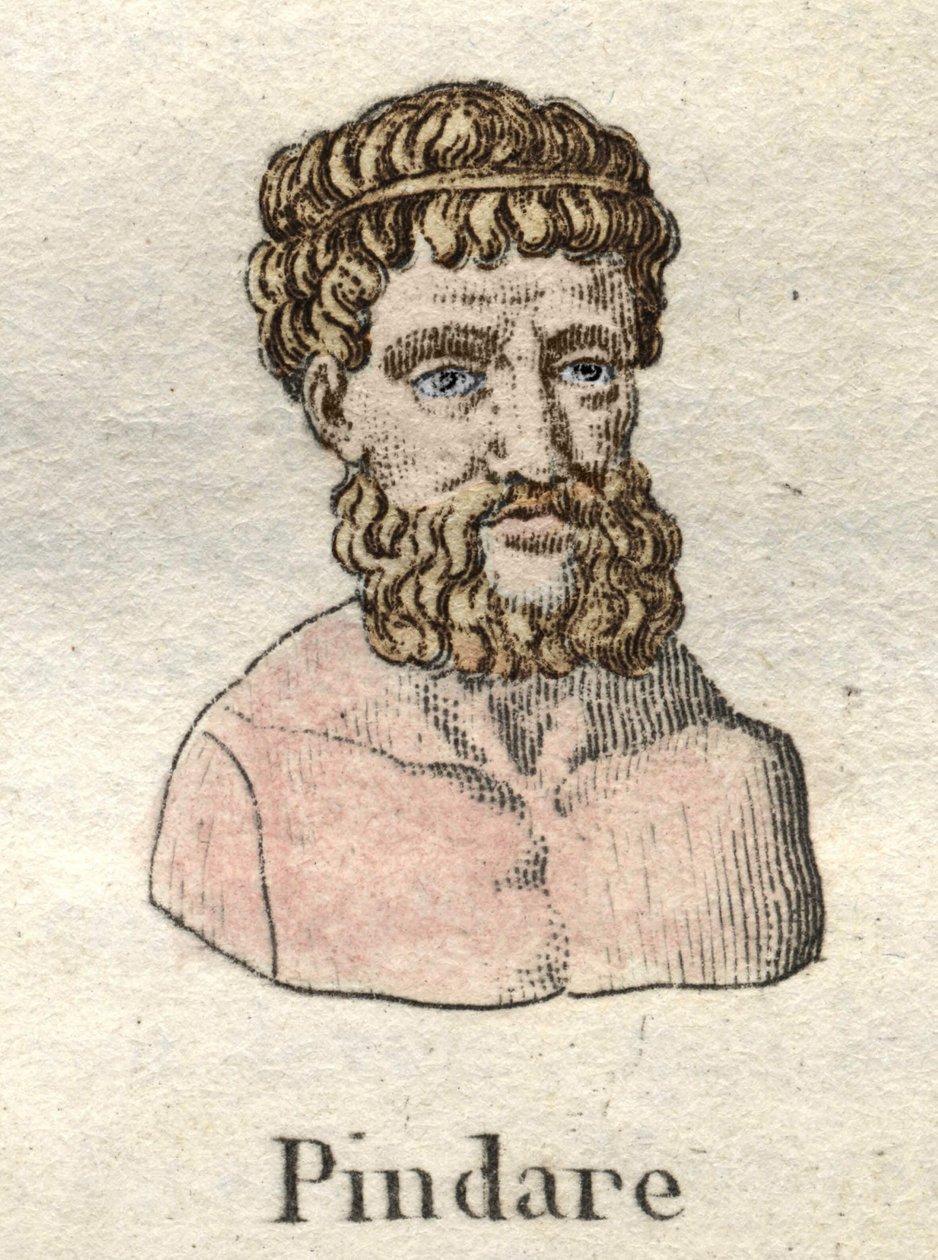
Of all the poetic personae in early Greek lyric poetry, none is quite so fascinating as Pindar. His surviving victory odes, a subsection of epinician poetry, are on the surface a simple exchange between patron and poet in which Pindar is paid to laud the victory of his commissioner. However, closer inspection reveals just how integral Pindar's poetic persona was to the political interests of the fifth-century aristocracy. In constructing himself as a moral guide, Pindar's odes seek to shape societal values that maintain the influence of the aristocracy within the polis and, through the example of Simonides, discredit anything that threatens this influence. He also acknowledges the potential re-performance of his poetry, writing in a way that secures the aristocracy's authority for generations to come.
In order that his poetry be taken as a serious guide of principles, Pindar paints himself as a pious figure and thus implicitly presents himself as a trustworthy moral guide, a man of great sophia. For instance, in Pythian 1, addressing the laudandus Hieron of Aitna, Pindar instructs him to 'Guide your people with a rudder of justice; on an anvil of truth forge your tongue' (86–7). The use of imperatives denotes that he has not only the authority but the wisdom to guide Hieron. The themes of this advice, justice and truth, serve to highlight Pindar's moral piety. That a man of great achievement (i.e. the winner of the chariot race at the Pythian games, and thus held in great regard) would come directly to him for guidance is indicative of Pindar's expertise in moral guidance. Hieron already has 'people' to 'guide', and thus Pindar acts as a leader of leaders, furthering his authority. In Olympian 1, he admonishes those who 'embellished [stories] beyond the true account and deceive by means of elaborate lies' (28b–30): by extension, his words are the utmost truth and should be taken as such by their audience.
With his moral reliability cemented, Pindar uses his praise poetry to subtly shape societal values. His superlative depictions of athletic victors as the height of excellence are seemingly typical of victory odes. In Pythian 1 he declares that Hieron has 'such honour as no other Hellene enjoys' (49), and in Olympian 1 Pindar is 'confident that there is no other host both more expert in noble pursuits and more lordly in power alive today' (103–5). The former's comparison of Hieron to the rest of the Greek world, paired with the latter's focus on the ability to wield power, seems to connect the superiority of these men with their social status. The vast majority of those who competed in athletic contests were aristocratic, and since it is these men who are lauded as the ideal of manhood, the odes send the message that the aristocracy are somehow innately superior to the rest of the polis. As a member of the aristocracy himself, who claimed descent from the Aegeidae, Pindar had every interest in maintaining its influence within the polis.
The most significant way in which Pindar upholds the aristocracy's power, however, is in his attitude to payment. In a famous passage from Isthmian 2, Pindar criticises the devolvement of poetry into something that can be sold:
For at that time the Muse was not yet
greedy for gain nor up for hire,
nor were sweet, soft-voiced songs
with their faces silvered over being sold
from the hand of honey-voiced Terpsichore.
But now she bids us heed the Argive's adage,
which comes … closest to the truth:
"Money, money makes the man" (6–11)
Harking back to a more wholesome time, Pindar paints the poetic Muse as a prostituted figure: the poetry is still beautiful in tone ('soft-voiced', 'honey-voiced'), but 'silvered', clouded by the 'greedy' nature of the Muse. The gnome '"Money, money makes the man"' stands in direct contrast with the pre-established morality of Pindar's poetic persona. Gnomai are a relatively typical feature of epinician poetry, usually used to give the poem a general moral alongside its praise of the laudandus, but Pindar uses this one ironically, as a representation of art's moral decline: he is clearly critical of any remuneration for poetry. This passage is thought to be a direct criticism of his contemporary, Simonides: the original Greek for 'greedy', φιλοκερδής, after all, is 'a negative term found also in the tradition concerning Simonides and money' (Rawles 2018, 137). With this, Pindar shaped Simonides' legacy into that of an avaricious poet. In Callimachus' Iambi (fr. 222), for instance, the speaker remarks 'For I do not bring up my muse a labourer as the Cean descendant of Hylichus [did]…' (Simonides was of the family of the Hylichidae), likely a direct reference to this passage and its 'labourer' Muse, that is, a Muse who works for direct payment.
On the surface, this criticism seems entirely hypocritical: Pindar also wrote poetry on commission and in theory received payment just as Simonides did. However, what Pindar criticises is the receipt of currency: he, by contrast, works within the economy of gift-giving. Although we cannot know for sure how much of his work relied solely on gifts as opposed to wages, Isocrates does refer to the 10,000 drachmae Pindar received from Athens as 'a δωρεά, "gift"': monetary or physical, it seems any remuneration Pindar received for his poetry was viewed within the aristocratic gift-giving system (Bowie 2021, 599). This system of gift-giving was essential to the preservation of the aristocracy's influence: since 'in many gift-exchange cultures objects of exchange are ranked hierarchically', certain types of gifts were tied to the aristocracy and thus separated them from the average member of the polis, establishing a hierarchy (Kurke 1991, 94). This system relied on close ties between those exchanging gifts, as highlighted in Pythian 1, where Pindar addresses his laudandus as 'O my friend' (92), further raising the status of the aristocracy, since their specialised mode of economy was closed off to those who did not have personal relationships with an aristocrat.
The gift-giving economy, as opposed to the emerging use of currency in ancient Greece, was also strongly tied to social values. For instance, as Kurke notes, 'athletic victory … [put the victor's] whole class in his debt. The poet acknowledges and accepts the debt, and by his gift of praise he reconstituted the community' (Kurke 1991, 102). This social debt is clear in the opening of Olympian 10, where Pindar apologises for the ode being late, saying that he had forgotten and thus owed the recipient a 'debt', but that 'interest on a debt can absolve one from a bitter reproach' (3–9). While this monetary language could simply refer to the exchange of goods, I see it as an insight into the more moral debt associated with the gift-exchange system. Gift-exchange was as much a social responsibility among the aristocracy as it was a functioning economy, and so Pindar's poetry also gives us insight into how this social exchange functioned.
His admonishing of Simonides is therefore a reflection of the threat the emerging system of currency posed to the aristocracy's influence within the polis. The close relationships essential to the gift-giving economy are broken down by currency, since anybody could feasibly pay anybody for a service. Thus any exclusivity bred by gift-giving's hierarchy of goods was in peril. Perhaps this is why, in Pythian 1, he declares that there is 'honour as no other Hellene enjoys as a proud crown for wealth' (49–50). The 'crown' as a symbol of ultimate arete not only ties ultimate honour to the aristocracy (since, as previously mentioned, they were typically the only class to compete in the games) but also assigns this honour to a physical object only members of the aristocracy could feasibly win and own. He even refers to it directly as a form of 'wealth', a clear attempt to maintain the relevance of aristocratic gifts in reaction to the threat of currency. His poetic persona is thus rendered a political tool for the aristocracy: they can both publicly broadcast their achievements and use them as a direct means to reinforce their power within the polis.
A distinctive feature of Pindar's poetic voice is also his clear concern for the re-performance of his poetry, and how this concern shapes his aristocratic propaganda. His attitude to Homer and Homeric imagery is most telling of this. As well as offering an obvious way to demonstrate the arete of his laudandus' victory, Homer was the established example of poetry that had stood the test of time: in incorporating this well-known imagery into his own poetry, Pindar could ensure that his message was understood for generations to come (and, by extension, that the aristocracy's future was secure). In Isthmian 4, on 'Aias' bloodstained valour', Pindar notes:
But Homer, to be sure, has made him honoured
among mankind, who set straight
his entire achievement and declared it with his staff
of divine verses for future men to enjoy.
For that thing goes forth with immortal voice
if someone says it well (36b–40)
The concern with 'future men', as well as the nod to Homer's 'immortal voice', is indicative of Pindar's concern with re-performance. This passage is directly followed by Pindar's appeal to the 'favour of the Muses' (44) for similar divine treatment, and so his use of Homer as an example subtly aligns Pindar's poetic voice with Homer's. Homer was an important figure for the aristocracy: his poetry 'offered a model for aristocratic self-definition in the face of encroachment and change' (Kurke 1991, 88). The values of athletic contests, arete, victory and strength, are all embodied by the heroes of Homer, and so alongside securing his poetic legacy Pindar also ensures that the social values of the aristocracy are sustained for generations to come.
There is also mention of the mode of re-performance. In Nemean 4, there is a reference to repeated re-performances of the poem:
If your father Timokritos
were still warmed by the blazing sun, often would he have
played an elaborate tune on the lyre, and, relying on
this song, would have celebrated his triumphant son (13–16)
This gives us an insight into how Pindar's poems would have been reused. The fact that it is the laudandus' own father playing the lyre, and that he chooses to recall a family triumph, suggests the symposium as a likely location for this re-performance. In theory, this is not the most effective way of fortifying aristocratic values in the polis, since a symposium was a performance within the private sphere and thus not broadcast in the same way as a victory ode's first performance. However, as Morrison points out, 'a performance at a victor's house could have a large, public audience made up of many of the citizens of a given polis' (2012, 114). Not only does this give scope for the affirmation of aristocratic values, but it also serves as a powerful means of preserving individual aristocratic families: the focus on family legacy in the above extract shows how Pindar formulated his poetry with aristocratic legacy in mind. He was concerned not just with the current state of aristocratic control, but with sustaining that influence.
No other poetic voice is quite as revealing of the intricacies of ancient Greek society as Pindar's. Serving as both an artistic and a political voice, his subtle manipulation of politics, hidden within epinician poetry, is a testament to the power of early Greek poetry. If nothing else, his ability to sully Simonides' poetic reputation for so long is a testament to the power of his poetic persona in shaping society itself.
Bibliography
Bowie, Ewen. "Epinicians and 'Patrons'" (2012). In Essays on Ancient Greek Literature and Culture, 594–603. Cambridge: Cambridge University Press, 2021.
Callimachus. Aetia, Iambi, Hecale and Other Fragments. Translated by C. A. Trypanis. Musaeus, Hero and Leander, translated by Thomas Gelzer and Cedric Whitman. Loeb Classical Library 421. Cambridge, MA: Harvard University Press, 1973.
Kurke, Leslie. "The Ideology of Aristocratic Exchange." In The Traffic in Praise: Pindar and the Poetics of Social Economy, 85–107. Ithaca: Cornell University Press, 1991.
Morrison, A. D. "Performance, Re-Performance and Pindar's Audiences." In Reading the Victory Ode, edited by Peter Agócs, Chris Carey and Richard Rawles, 111–133. Cambridge: Cambridge University Press, 2012.
Pindar. Nemean Odes. Isthmian Odes. Fragments. Edited and translated by William H. Race. Loeb Classical Library 485. Cambridge, MA: Harvard University Press, 1997.
Pindar. Olympian Odes. Pythian Odes. Edited and translated by William H. Race. Loeb Classical Library 56. Cambridge, MA: Harvard University Press, 1997.
Rawles, Richard. "Pindar, Simonides and Money: Pindar's Isthmian 2." In Simonides the Poet: Intertextuality and Reception, 133–154. Cambridge: Cambridge University Press, 2018.

Read next, in Classics