

Classics · Essay · The Weekly, No. 6
A Goddess of Love and War: Reconciling Ishtar and Venus
Tracing Ishtar's journey to Aphrodite and Venus, and how her suppressed features reappear
Alec Grinter · University College London · 7 September 2026
University College London · 7 September 2026
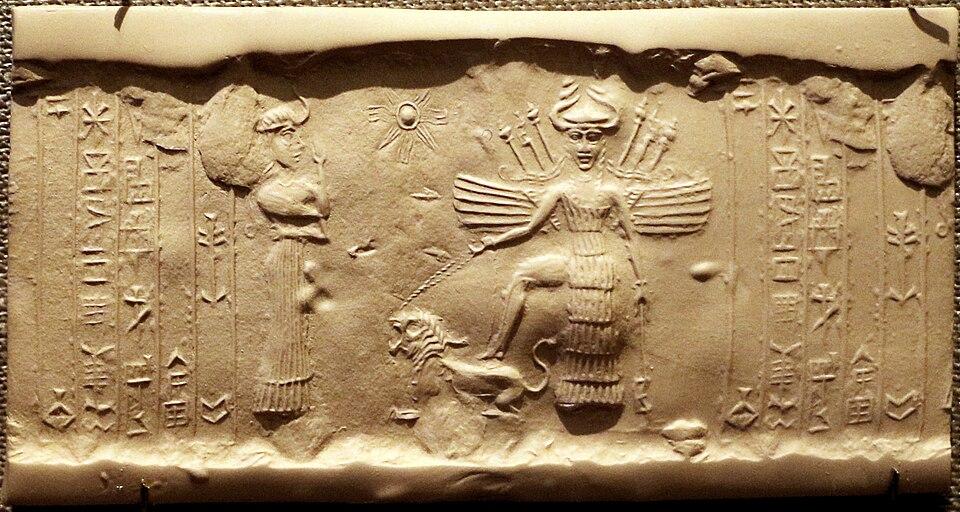
The evolution of the Mesopotamian goddess Ishtar to the Hellenic Aphrodite has long been explored and mapped, with the 18th century interest in comparative mythology leading to a rise in interest in the cultural exchange between the Mesopotamian and Greek worlds. But little focus has been placed on her later manifestation as Venus, and what this can reveal about the foundations of her identity as a deity of love and war.
Ishtar (her Akkadian name) began as Inanna, a Sumerian goddess of love, fertility and war, and was often equated with the planet Venus. In Sumerian, her story revolves around her marriage to the mortal shepherd Dumuzi, whom she holds an intense loyalty and passion for. She is known for being fiercely protective of anyone who threatens her relationship with Dumuzi (Wolkenstein, 1983). However, Ishtar is most well-known for her later Akkadian role in the Epic of Gilgamesh , characterised by her intense and graphic sexuality, and subsequent rejection by the protagonist (George, 2020). Immediately in her short timeline, we see a stark contrast in two presentations of the same goddess who governs the same qualities. Ishtar-Inanna is both the perfect adoring wife and a sexually charged femme fatale, and there is no attempt to reconcile their inconsistencies.
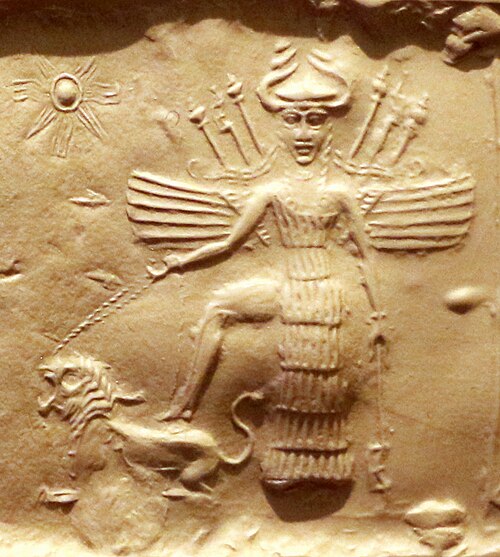
(Ishtar on an Akkadian seal)
Her war aspect most clearly comes into the picture in her relationship with Sargon, the most famous Akkadian king. The first to conquer the Sumerian territories, it is one of the first time Mesopotamians have to reconcile their contrasting views of the same deity. Scholars have used the phrase “dynasty of Ishtar” (Harris, 1991) to encapsulate the way in which Sargon uses her to legitimise his conquests and reign over such an expansive area. Ishtar was a war goddess primarily due to her strong connection with fertility and femininity, with the Babylonian comparison of bloodshed in battle to childbirth creating the perfect image of a powerful mother goddess guiding the king. The propaganda in Akkadian epic poems of Sargon utilises Ishtar’s multifaceted image to create an image of total control, thus she gains respect in her identity as a goddess of war.
Having established who Ishtar was and how she was used, we must turn to her later appearance as Aphrodite. The Phoenicians (the primary traders and merchants of the time) borrowed Ishtar from Mesopotamia, renaming her Astarte, a heavily-worshipped goddess in Near Eastern port towns (Buddin, 2004). With so much trade between the Phoenicians and early Greeks, it is no wonder that a goddess of love and war began to appear along Greek trade routes, such as in Paphos, Cyprus. It is no coincidence that Aphrodite was said to have emerged from the sea in this area, representing her entrance into the Greek world. Her birth myth provides important context for the Greek view of the goddess: a mysterious goddess who rose from the oceans to the edge of the Greek (read civilised) world. However, the later perception of Greek Aphrodite does not yet align with the fiercely powerful Ishtar.
With a cult growing in Paphos, Aphrodite’s worship spread slowly to the Greek mainland, where it reached Sparta, well-known as a hub for warfare. There, she was worshipped only in her function as a war goddess, with the epithet Aphrodite Areia, “warlike Aphrodite”. She was a goddess of strength, warfare and protection, worshipped through armed statues and often thanked after battles. Her love aspect was little expressed in her manifestation in Sparta, her fertility quality being expressed instead through the bounty of war (Graf, 1984). Although later Greeks and we today may see Aphrodite as a girlish goddess of love, her foundations are fundamentally warlike, and we are left to wonder where those foundations went.
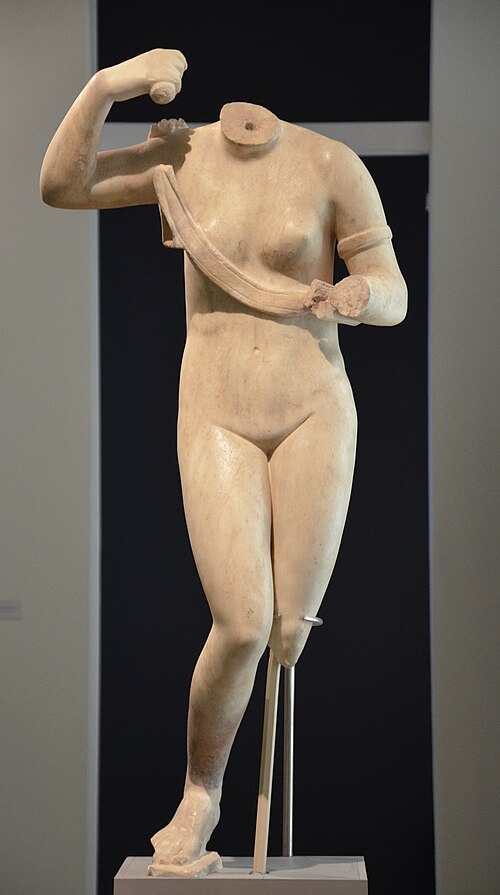
(An armed statue of Aphrodite Areia from Cyprus)
Book Five of the Iliad sees Homer (2023) take a starkly different perspective on Aphrodite to the one of feminine strength we have seen so far in Sparta. Having extracted her beloved Paris from the battlefield, saving him from defeat but prolonging the war, she is berated by her (in this story) father Zeus, who insists that her rightful place as a woman is away from the battlefield. Although later in the epic he will berate all the gods for all their involvement as immortals, in this moment he is only concerned with Aphrodite’s femininity in relation to battle, rather than her immortality. This moment feels odd and disjointed compared to the tale of bravery and warfare seen in the first four books, so we are led to question why Homer chose to place this scene in amongst the fighting.
An answer could lie in that this scene is a deliberate rebellion against the idea of Aphrodite as a war goddess; Aphrodite being perceived as a figure of war was likely not received well by the patriarchal structures of the Greek world, so through explicitly scolding her for becoming involved in the masculine world of battle, Homer eradicates any idea that her war capacity holds substance. This scene thus prevents a contemporary Greek from understanding Aphrodite’s power in warfare. But looking back, Homer’s attempt to rectify the idea of a female god of war only consolidates our understanding of her evolution. Aphrodite doesn’t simply lose her warlike aspect: it is actively stripped from her in a patriarchal fight for dominance.
While Homer still gives us Athene as a goddess of war, she is only a shadow of what Aphrodite Areia could have been. Athene takes to the background, restraining Achilles against Agamemnon, guiding Diomedes and Odysseus through whispers, whereas the portrayal of Aphrodite in Sparta, on display for all to worship, shows us an immortal woman who stands in the spotlight and boldly takes charge.
As conservative Athens began to dominate the Peloponnese, their Homeric Aphrodite as simply a love goddess with no war connection gradually began to dominate the entire Greek world. Aphrodite caused chaos to get couples together and wouldn’t mind a bit of violence to let her plans fall into place, but real, strategic warfare was left to Athene, who was still exonerated primarily for her virginity and thus had no connection to expressions of female sexuality in the same way as Aphrodite.
So this character development spanning millennia takes us to the Roman adoption of Greek figures. Venus could arguably be even less warlike than Aphrodite, as one of her earliest Latin epithets is Venus Obsequens, “obedient Venus”, an attempt to convert her sexual nature from wild and unconventional into something controllable and appropriate for Roman women. All sense of the overwhelming power of Ishtar is gone, and even Aphrodite’s control is only a memory, which makes it so extraordinary that we see the image we do in the Augustan period.
While the Venus of the Aeneid (Virgil, 2006) does not always treat her son, Aeneas, well, she is in this defining epic first and foremost a mother. As the mother of Aeneas, she is therefore the mother of the Roman race, the divine connection Augustus repeatedly emphasises to legitimise himself. Augustus, as the first Roman princeps (the title that would later become synonymous with emperor), needed to prove himself a strong and capable ruler, and how better to do that but with the favour of the gods. Already holding a supposed familial connection to Aeneas, Augustus could portray himself as a descendant of Venus, who would bring glory to Rome with the favour of the divine.
In the Augustan period, Venus is transformed. Her roots as a Mesopotamian war goddess return in some sense, in the form of Venus Genetrix, “Venus the Mother”. She becomes the heart of the Roman pantheon, as she is the connection all Julio-Claudian emperors hold to the approval of the gods. She watches over cultic sacrifices and ritual prayers at the Ara Pacis (“the Altar of Peace”, Thornton, 1983), she ensures the emperor returns safe from battle, she provides Rome with its divine lineage, and in doing so she gains back some of her power.
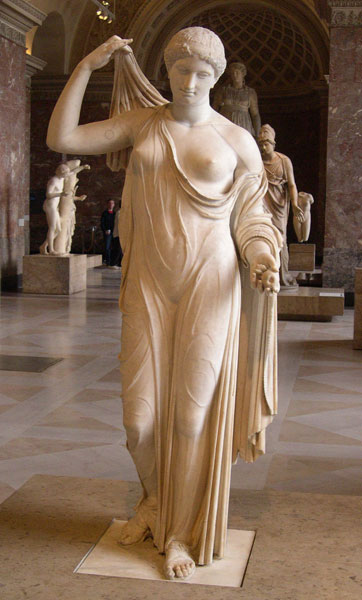
(Venus Genetrix as a common sculptural type)
Although Venus cannot be said to have nearly the force Ishtar once did, it is remarkable that this figure of feminine power had so much taken from her yet gains it back in her Roman form. While the Roman world was by no means feminist, they allowed this feminine figure to gain back some of her authority. In the hands of men, Aphrodite became a superficial matchmaker, but in Venus she took back some of what made her once a unique woman in the ancient world.
Bibliography
Buddin, S. (2004). ‘A Reconsideration of the Aphrodite-Ashtart Syncretism’, Numen, 51(2), pp.95-145.
Graf, F. (1984). ‘Women, War, and Warlike Divinities’, Zeitschrift für Papyrologie und Epigraphik, 55, pp.245-254.
Harris, R. (1991). ‘Inanna-Ishtar as Paradox and a Coincidence of Opposites’, History of Religions, 30(3), pp.261-278.
Homer. Iliad Book V. Translated by Emily Wilson (2023).
Marcovich, M. (1996). ‘From Ishtar to Aphrodite’, The Journal of Aesthetic Education, 30(2), pp.43-59. doi: 10.2307/3333191.
Pomeroy, B. (2008). ‘Spartan Women among the Romans: Adapting Models, Forging Identities’, Memoirs of the American Academy in Rome, Supplementary Volumes, 7, pp.221-234.
Thornton, M. (1983). ‘Augustan Genealogy and the "Ara Pacis"’, Latomus, 42(3), pp.619-628.
Unknown. The Epic of Gilgamesh. Translated by Andrew George (2020).
Virgil. Aeneid. Translated by Robert Fagles (2006).
Wolkstein, D. (1983) ‘The Courtship of Inanna and Dumuzi’, in Inanna, pp.34-49.

The author
Editor of Classics and Ancient Languages student at UCL primarily interested in the Ancient Near East and comparative studies
All work by this author →Read next, in Classics