

Literature · Essay · From the archive
The Role of Swiss Neutrality in "The Visit"
How do national politics and personal beliefs influence dramatic work?
Alec Grinter · University College London · 14 September 2026
University College London · 14 September 2026
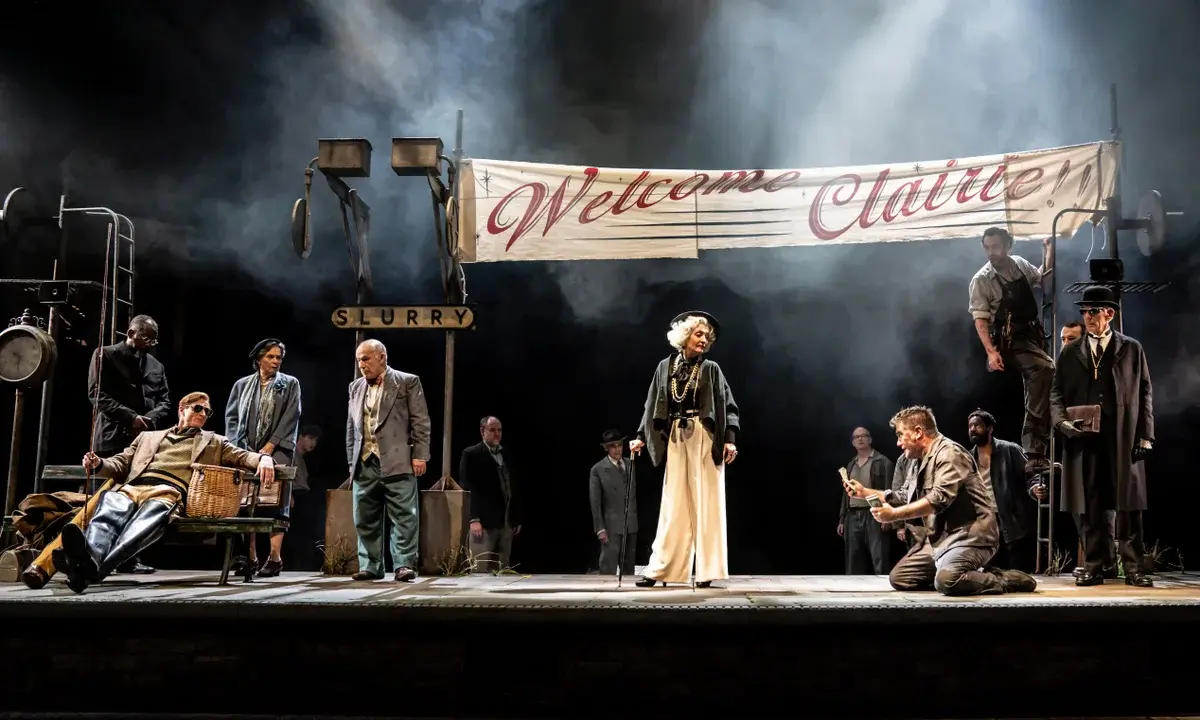
To truly understand the intentions behind Friedrich Dürrenmatt’s tragicomedy “Der Besuch der alten Dame” (The Visit of the Old Lady, known in English as just “The Visit”), one must understand Dürrenmatt’s attitude towards the role of Switzerland’s, his homeland’s, neutrality, especially during World War Two. The play’s setting in the fictional town of Güllen is modelled around post-war Switzerland and clearly reflects the playwright’s views of the nature of his homeland’s greed and complicity in World War Two. Through the play, Dürrenmatt critiques various aspects of Switzerland’s lack of action, such as the role of economy and the government, as well as the ordinary people of Switzerland. For this reason, understanding national issues in Switzerland and Swiss people’s views of their country is key to understanding the intentions behind “The Visit”.
The play centres around the eponymous visit of billionaire Claire Zachanassian to her hometown of Güllen, with the town relying on her to donate significant funds to save their declining and impoverished town. Zachanassian offers them the money, on the condition that the townspeople kill her ex-lover Alfred Ill, a well-respected member of the community. Although initially outraged, over the course of the play the townspeople give in and murder Ill to save themselves from ruin. The play serves as a moral lesson about greed and complicity, but more than that it can be examined to reveal the playwright’s personal beliefs within his historical context.
The town of Güllen acts as a microcosm of immediately post-war Switzerland. With a made-up name from the noun “die Gülle” meaning “sludge”, at the beginning of the play Güllen is an impoverished town, being described in the stage directions as “ruined, destroyed (“ruiniert, zerfallen”), in desperate need of money. They want to convince higher-powered Zachanassian to donate money to repairing the town above all else, which represents how Dürrenmatt saw Switzerland’s attitude towards the Axis powers: an economic opportunity.
Although the 1946 Washington Agreement supposedly ended Swiss-German economic ties, Nazi gold, which remained in Swiss banks until it was found the mid-90s, was vital to the Swiss economy (Foy, 2023). Dürrenmatt of course viewed this dependence as abhorrent and heavily critiques it through the townspeople’s relationship with Zachanassian, with them appearing to reject her money and valuing Ill’s life more at first, with the Mayor refusing Zachanassian “in the name of humanity” (“im Namen der Menschlichkeit”). However, as the play progresses, the townspeople abandon this viewpoint in favour of accepting Zachanassian’s money. They become freer with spending money they do not yet have, supposedly because “one is surely still allowed to dream” (“man wird doch wohl noch träumen dürfen”), despite this seeming to be a sign they are about to come into money from Zachanassian. This spending significantly increases the townspeople’s reliance on Zachanassian as they now need her money to make up for what they have spent, despite supposedly being against the act she wishes them to commit – in a similar way to how Switzerland became reliant on the German economy both pre- and post-war, despite seeing the clear extremist direction German politics was veering into.
Dürrenmatt also uses the play to heavily critique the Swiss rejection of Jewish refugees during the war and the country’s complicity in Nazi persecution of Jews. By claiming they were racial rather than political refugees, Switzerland were able to legally deny Jewish refugees asylum status and not allow them to cross the border. Under pressure from Nazi Germany, Switzerland regulated Jewish citizens by having a red ‘J’ stamped on the front of their identification documents to make them easily identifiable (Yad Vashem). In these ways, Dürrenmatt views the Swiss government as being complicit in the Holocaust and Nazi persecution. With these historical factors in mind, it is clear to see reflection of personal viewpoints in the townspeople of “The Visit”. Despite Ill claiming “one cannot just buy justice” (“die Gerechtigkeit kann man doch nicht kaufen”), the Mayor’s claim that “the necessity to save our town” (“die Notwendigkeit, unsere Stadt zu retten”) means Ill must die to claim the money Zachanassian has offered. This is a complete reversal of the Mayor’s earlier perspective that it was inhumane to kill one person for the good of the whole, showing that Güllen is a place of greed and only focused on its own needs, rather than the “humanity” (“Menschlichkeit”) it had claimed to care for. The later acts of the play demonstrate the hypocrisy Dürrenmatt sees in Switzerland’s attitudes towards Jewish refugees during the war, with Switzerland claiming to stay neutral yet still giving in to Nazi demands regarding the treatment of Jews.
Through the presentation of the people of Güllen, Dürrenmatt places blame not only on the Swiss government but also on Swiss society as a whole, believing the people also play a key role in the complicity of a country in genocide. The Mayor is the main individual spokesperson for the town’s citizens, while the people speak together as a chorus, representing the unity of the society and lack of blame on one particular person, but rather on the society as a whole for their decision on killing Ill. While at first the Mayor claims that “no one wants you to die” (“Niemand will Sie töten”), at the end the chorus of townspeople chant in unison “one for all, all for one” (“einer für alle, alle für einen”). As a slogan often associated with Switzerland and its stance on neutrality, here it explicitly and ironically highlights the moral corruption of the people of Güllen and their justification of the collective murder. It serves to highlight Dürrenmatt’s idea that patriotism (in this case towards Switzerland) can be so easily twisted into a nationalistic complicity and silence in the name of preserving their own country. Hence, the townspeople are used to highlight the actions of the everyday Swiss people, who were complicit in their government’s lack of action towards the Nazi persecution of Jews and many other minority groups.
Dürrenmatt clearly views the attitude of the Swiss government towards Nazi Germany as one of greed and selfishness which is inexcusable, using “The Visit” to illustrate this. Historical events influence his portrayal of critiques, especially in regard to the Swiss reliance on Nazis for the upkeep of their economy, while also highlighting the role of the people of Switzerland through the use of Güllen’s townspeople. Throughout “The Visit”, it becomes increasingly clear that commenting on Swiss morality is Dürrenmatt’s primary reason for writing the play in the way he did, so knowledge of these events is vital in understanding the characters and plot development.
Bibliography
Dürrenmatt, F. (1951). "Der Besuch der alten Dame"
Dürrenmatt, F. (1990). "Die Schweiz - ein Gefängnis"
Foy, S. (2023). "Are Swiss banks still hoarding Nazi gold?". Available at: https://www.telegraph.co.uk/business/2023/05/06/swiss-banks-nazi-gold-credit-suisse/
Yad Vashem - The World Holocaust Memorial Centre. "Switzerland". Available at: https://www.yadvashem.org/righteous/stories/switzerland-historical-background.html

The author
Editor of Classics and Ancient Languages student at UCL primarily interested in the Ancient Near East and comparative studies
All work by this author →Read next, in Literature