

Literature · Essay · From the archive
Robin Hood, Dante and Saint Augustine: Theology, Poetry and Folklore in Sherwood Forest
Corrupt kings, jaded children and boisterous friars. How an old legend keeps company with Dante's Commedia and Augustine's City of God.
Alex Boyd · University of Nottingham · 25 September 2026
University of Nottingham · 25 September 2026
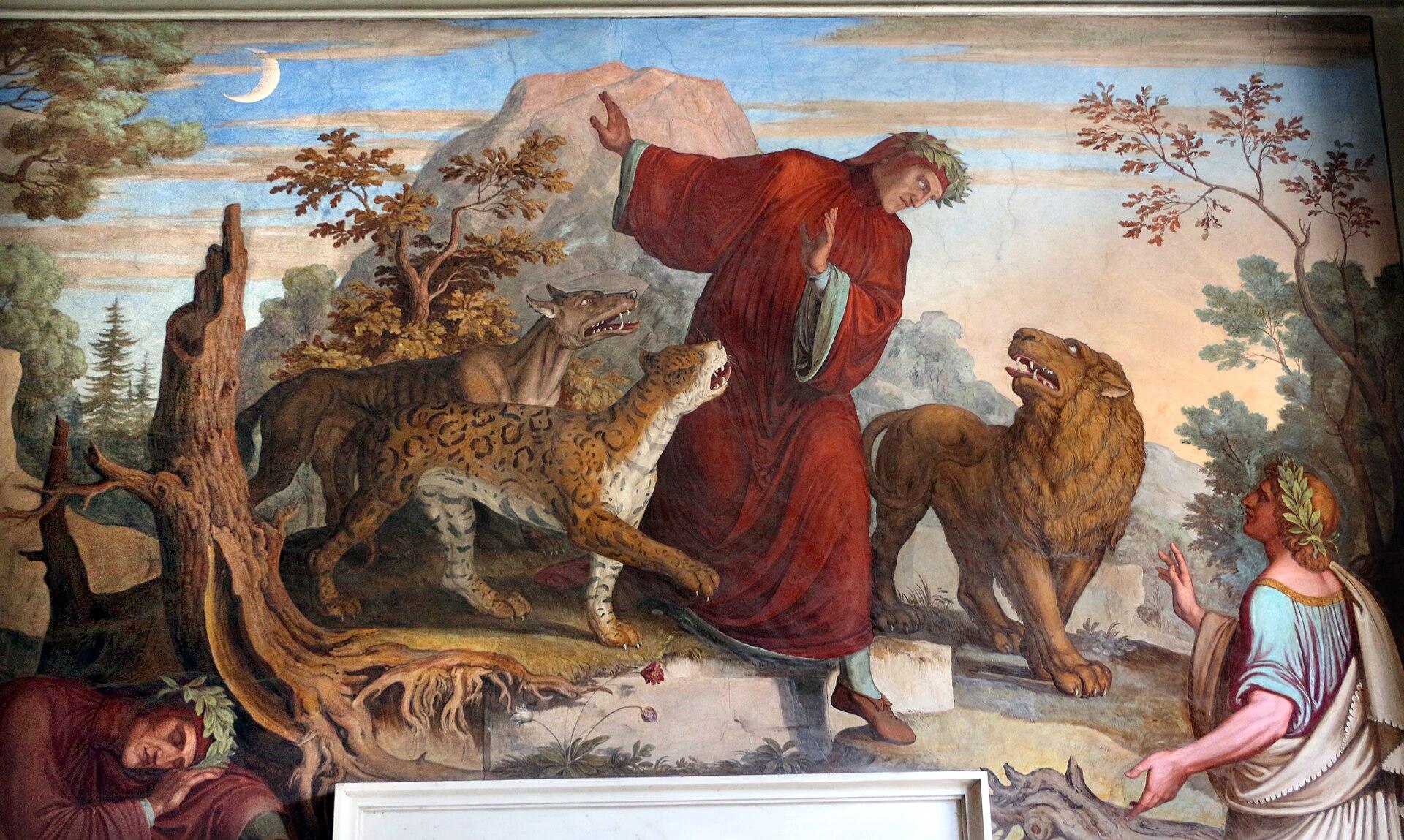
Augustine held that sin is not a matter of loving too much, but of loving the wrong things in the wrong order. According to his ordo amoris, we are to love God above all, our neighbours above ourselves, and lastly, the love of ourselves should flow from the wellspring of the first two loves, seeing ourselves as servants of God and others. Justice, therefore, should seek not to punish with vengeance, but to first gently seek to reorder the love of the offender. Centuries later, we see Dante exploring this philosophy in the Divine Comedy, especially the Purgatorio, where every soul is healed by the painful process of learning to love rightly. Here I seek to follow this, albeit winding, scarlet thread among these three authors, the stories they told, and the ideas they shared regarding the map of the human heart, a roadmap that, whether ruler or peasant, priest or pagan, can lead us down a path of either restoration or destruction.
The Outlaw and the King
Roger Lancelyn Green's Robin Hood, in his 1956 retelling The Adventures of Robin Hood, is less interested in redistributing wealth than in confronting every institution that has forgotten what authority is for. In fact, Robin Hood himself was once an Earl: Robert Fitzooth, Earl of Huntingdon, a Saxon Earl who was able to keep his lands despite living amongst the victorious Norman invaders of England. Upon the discovery of his outlawry and the renouncement of his earldom, he says to his hypocritical accusers:
'Why then,' came the quiet answer, 'Here and now Robert Fitzooth, Earl of Huntingdon, ceases to be. You have called me Robin Hood: both you and your sheriff, yes, and Prince John himself shall live to fear that name. And not only you, but all those like you: the abbots and bishops who grow fat on the sufferings of the poor; the Norman knights and barons who break the king's law and the law of God in their cruelties and oppressions, yes, and all their kind shall go in terror so long as Robin Hood reigns in Sherwood Forest: in Sherwood, and wherever else wrongs need to be righted, until King Richard comes home from the crusade and there is justice once more in this fair land of England.'
Right from the beginning, then, it is clear that Robin Hood is not the anarchist many of us may have thought him to be. In fact, his dedication to Justice and loyalty to the rightful king resembles something more akin to Aragorn returning to the throne of men or Dante's reverence for the Holy Roman Emperor and the establishment of a perfectly just and spiritually aligned government. In the opening lines of Inferno, as Dante comes face-to-face with the she-wolf (greed), or Prince John for our purposes, Virgil utters a prophecy: that someday an Emperor would come who would defeat the greed of church and empire before marrying the two in a perfect union:
‘the beast that is the cause of your outcry (the greedy she-wolf)
allows no man to pass along her track,
but blocks him even to the point of death;
her nature is so squalid, so malicious
that she can never sate her greedy will;
when she has fed, she's hungrier than ever.
She mates with many living souls and shall
yet mate with many more, until the Greyhound
arrives, inflicting painful death on her.
That Hound will never feed on land or pewter,
but find his fare in wisdom, love, and virtue;
his place of birth shall be between two felts.
He will restore low-lying Italy for which
the maid Camilla died of wounds,
and Nisus, Turnus, and Euryalus.’
(Inferno 1.94–108, trans. Allen Mandelbaum; parentheses mine)
Richard Lionheart occupies a role in Green's imagination that echoes Dante's Greyhound. He will not, like Prince John and his corrupted, greedy clergy, feed off the land and pewters of others, but will restore low-lying England to its former glory, both church and state.
Two Kingdoms in Sherwood
Robin Hood's place between the two kings and what they resemble is also a shadow of the Earthly and the Heavenly cities discussed by Saint Augustine in The City of God. According to Augustine, any city devoid of the worship of God is merely a band of robbers operating on coercion, greed, and power rather than virtue. As Robin Hood recruits his followers in Sherwood Forest to resist the injustice of Prince John and his Clergy, he begins to form a kind of city of his own, each calling the other "thief" and "outlaw". One uses their power to circumvent the spirit of the law, the other using their influence to challenge the letter of the law in favour of actual justice on behalf of the people. Augustine uses a fictitious encounter between Alexander the Great and a pirate that illustrates the conflict between Prince John and Robin Hood: that without true justice, governments and empires are merely large-scale criminal enterprises.
‘Justice being taken away, then, what are kingdoms but great robberies? For what are robberies themselves, but little kingdoms? The band itself is made up of men; it is ruled by the authority of a prince, it is knit together by the pact of the confederacy; the booty is divided by the law agreed on. If, by the admittance of abandoned men, this evil increases to such a degree that it holds places, fixes abodes, takes possession of cities, and subdues peoples, it assumes the more plainly the name of a kingdom, because the reality is now manifestly conferred on it, not by the removal of covetousness, but by the addition of impunity. Indeed, that was an apt and true reply which was given to Alexander the Great by a pirate who had been seized. For when that king had asked the man what he meant by keeping hostile possession of the sea, he answered with bold pride, 'What thou meanest by seizing the whole earth; but because I do it with a petty ship, I am called a robber, whilst thou who dost it with a great fleet art styled emperor.'
(City of God 4.4, trans. Marcus Dods)
The pirate's question hangs over Green's Sherwood Forest just as surely as it hangs over Augustine's empire and Dante's Florence: What makes authority legitimate? Is it power? Law? Birthright? Military might? Or something deeper? What ties these three works together, then, is the question of Justice and what it means to live and rule rightly. That's the question that Dante, Augustine, and Green are seeking to answer, and I think they all very clearly land on the same space of land. True Justice and rule are the fruit of rightly ordered love, and when we look at these two "kingdoms" as Green presents them, with the help of Dante and Augustine, we begin to see Sherwood as a precursor of the Heavenly City of perfected loves, and England under Prince John as its antithesis.
"It Is for Justice That We Fight."
This Augustinian view of justice, later dramatised by Dante, is present from the beginning of Green's Adventures of Robin Hood. After Much the Miller is killed by the Sheriff's men for hunting the king's deer, his son approaches Will Scarlet, Robin's second in command, and says,
'Good Will Scarlet … Let me come with you and serve your noble master (Robin Hood) too. I know I am but twelve years old, but sorrow brings us quickly to manhood, and I would be revenged on these accursed murderers.' To which Will Scarlet responds, 'Speak not of revenge … It is for justice that we fight.'
This distinction between revenge and justice echoes a climactic moment in Dante's Purgatorio, Canto XXX. When Dante encounters Beatrice on the edge of the Earthly Paradise, she welcomes him with rebuke rather than sentimentality, because he had allowed his loves to become disordered after her death. Her correction is not intended to be vindictive even though Dante takes it rather harshly. Rather, like Will Scarlet's insistence that "it is for justice that we fight," Beatrice's stern words seek not revenge for a personal wrong but the restoration of Dante's soul to its proper end. In the fifteenth-century ballad Robin Hood and the Monk, Much the Miller's son is not a wide-eyed youth as in Green's adaptation but a formidable, aggressive and sometimes reckless fighter, killing a monk's page to ensure the secrecy of a mission. Green, I think, deliberately softens the older tradition. Rather than introducing Much as an already capable fighter, he introduces him as a grieving child standing at the crossroads between vengeance and justice. His first lesson in Sherwood is not how to draw a bow, but how to begin getting his heart in order. Only once he masters his loves does he become a loyal and formidable fighter in service of Sherwood Forest.
Much is not the only character in Green's Adventures whose loves must be rightly ordered. The Church itself is treated as a child waylaid by its untempered greed, but just as Much has Will Scarlet and Dante has his Hound of Heaven, the English church has Friar Tuck, who stands against corrupt abbots and bishops, and whose loyalty is not to ecclesiastical office or political convenience, but to the justice and charity those offices were meant to serve. When Maid Marian's father comes to him asking him to deem her marriage to Robin Hood illegitimate, Friar Tuck says,
‘Marriages … are made in Heaven. Love is God's work.’
Dante and Augustine do not ask simply what we love, but whether our loves are directed toward their proper ends. Prince John and the greedy abbot love wealth and power; Much the miller's son initially loves vengeance until he is gently corrected; Friar Tuck loves God first and therefore is able to love Marian rightly. Love is God's work, and until those in power see love, including their own, as God's work, true Justice will not enter the gates of their cities. Here Friar Tuck, himself a member of an institution, speaks truth to power gently. Later on in Green's anthology, however, the gloves come off a bit as the Sheriff and his men attempt to cross a bridge guarded by the good friar in their search for Robin Hood and his men.
A Shepherd Among Wolves
Armed not with a sword but with a quarterstaff, Friar Tuck plants himself alone upon a bridge in Sherwood Forest under the assault of the sheriff, standing between the sheriff's men and the path to Robin Hood. When the Sheriff of Nottingham and his men attempt to cross, a conflict ensues, and Friar Tuck makes quick work of them with his quarterstaff. In Disney's 1973 film adaptation, the confrontation between the Friar and the Sheriff happens not on a bridge but in Tuck's own church as the Sheriff comes to collect taxes.
"You thievin' scoundrel!" He says, "collectin' taxes for that arrogant, greedy, ruthless, no good Prince John!" The Sheriff attempts to sidestep these accusations before Friar Tuck yells, "GET OUT OF MY CHURCH!" Drawing his quarterstaff, he fends Prince John's muscle out the door. A fight ensues, the Sheriff drawing his sword and Tuck sticking to his wooden staff, before Friar Tuck is eventually arrested and taken to jail.
Friar Tuck here does not wield his staff to dominate the battlefield. Instead, he stands between violence and the innocent, correcting evil rather than indulging it or piercing the flesh that bears it. A shepherd's staff is not just for the sheep but for the wolves as well. Like Beatrice's rebuke or Will Scarlet's correction of Much, his authority is restorative before it is punitive. This is the vision of a Church whose love is rightly ordered. Friar Tuck loves God, his Church, and his neighbours before he loves himself. His figurative opposition to Prince John is almost more impactful than his literal combat against the tyrant. He is, in a sense, the precursor of Dante's Greyhound, a prophet of Augustine's Heavenly City, a kind of steward for King Richard's throne. He is, as discussed here, a voice crying in the wilderness, preparing the way for the Lord who will come to both set tables and to flip them. He can do this not due to any merit of his own, but because his heart has been properly oriented.
Setting the World in Order
Nearly every act of violence committed by Green's heroes in the novel is preceded by an act of correction. Will Scarlet corrects Much before teaching him to fight. Friar Tuck corrects Marian's father before correcting the sheriff. Robin repeatedly offers mercy before punishment, inviting every enemy and friend to dine at his table in the woods before passing judgment. Justice in Green's Adventures is never divorced from the restoration of love.
Perhaps that is why Robin Hood has endured for so many centuries without a wealth of definitive "original" lore. Every age produces its own sheriffs, bishops, princes, and abbots who mistake power for righteousness. Green reminds us that the real outlaws are not the men who live outside the letter of the law, but those who use power to create their own self-serving definitions of justice. Robin Hood's arrows are aimed less at wealth than at corruption, and his deepest loyalty is not to rebellion itself, but to the hope that one day the rightful king will return and set the world in order. I think there is something uniquely human about this hope, which is why it appears in stories everywhere throughout the centuries.
Bibliography
Augustine. The City of God. Translated by Marcus Dods.
Dante Alighieri. The Divine Comedy: Inferno and Purgatorio. Translated by Allen Mandelbaum.
Green, Roger Lancelyn (1956). The Adventures of Robin Hood.
Robin Hood and the Monk (fifteenth century). Child Ballad 119.
Robin Hood (1973). Directed by Wolfgang Reitherman. Walt Disney Productions.

The author
A medievalist with a passion for popularizing the unsung texts of the medieval world in all their glory.
All work by this author →Read next, in Literature
- Sir Ian McKellen and “The Strangers’ Case” Edward Clark
- Second and Ten Dale Hinnsworth
- The Messy Yet Parallel Succession Claims in House of the Dragon and Mahabharat Adit Chandrachud