

Literature · Essay · From the archive
Daughter of the Earth: Sita's Refusal in Sita's Ramayana
A Reading of the Textual and Visual Resistance in Arni’s Sita’s Ramayana
Rhea Jaggi · 16 September 2026
16 September 2026
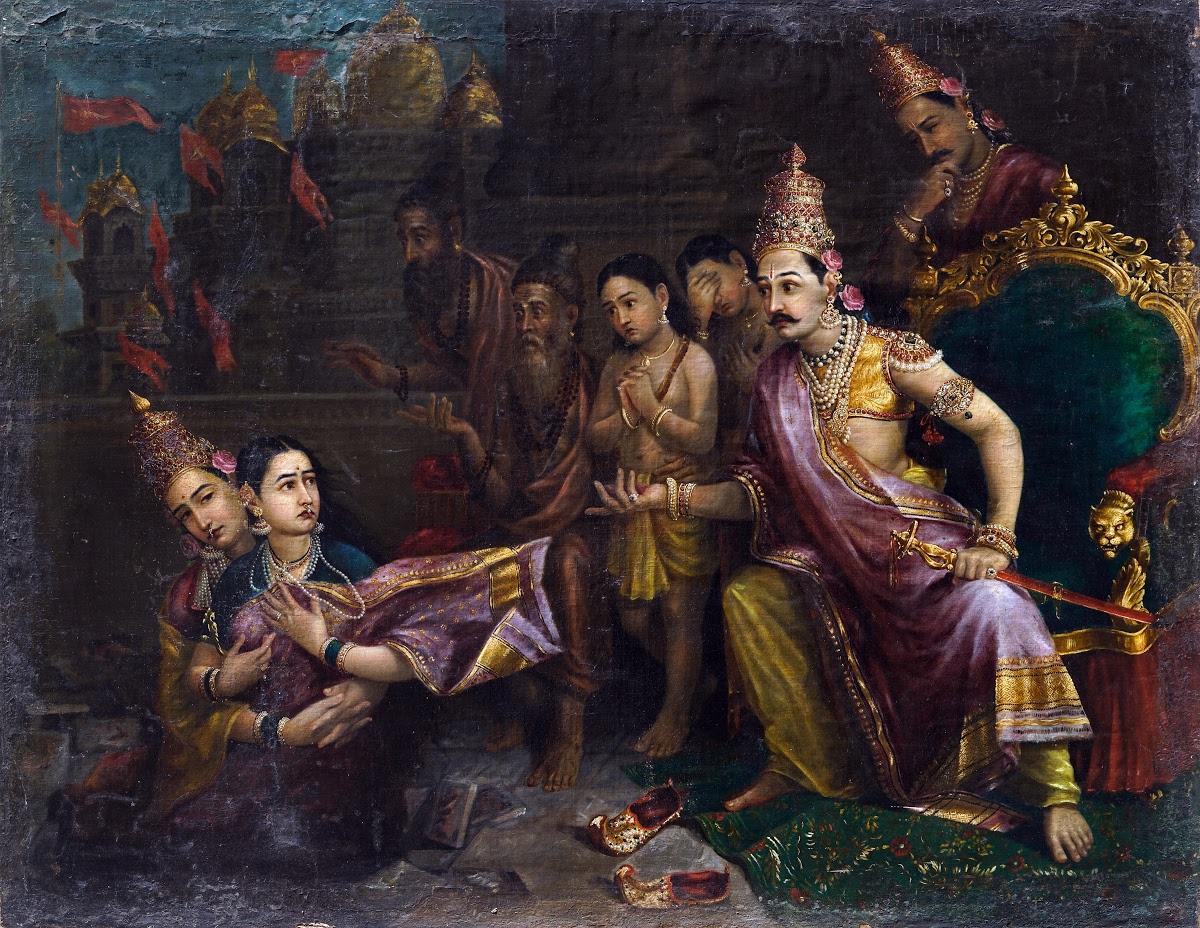
The Ramayana, the ancient Sanskrit epic attributed to the sage Valmiki and thought to have been composed between 500 BCE and 100 BCE, has shaped cultural norms and gender roles in India for more than two thousand years (Johari, 2023). Valmiki's version is often treated as the most authoritative. Its outline is simple, the righteous triumphing over the wicked, but the story it tells is complex and contested. Are these ancient epics as straightforward as the bedtime versions suggest, or do they carry deeper ideas?
Feminist scholars have long criticised the epic for promoting patriarchal gender structures, celebrating masculine heroism and presenting its women as statues of conventional virtue: self-sacrifice, devotion to the husband, and little individual autonomy (Hongal & Kshirsagar, 2023). These virtues explain the position from which Arni's retelling begins. In traditional tellings Sita, the epic's heroine, is not simply a woman who suffers; she is a character whose agency has been defined through her obedience and sacrifice.
Sita's Ramayana, a graphic novel written by Samhita Arni and illustrated by Moyna Chitrakar, was published by Tara Books, with Groundwood Books in the United States and Canada, in 2011. It adapts the story to follow Sita's encounters with oppression, looking beyond the victories and defeats of Rama and Ravana, and sets itself against the glorified Sita of Valmiki. Rani and Godwin (2022) identify it as a revisionist narrative: it places her experience of oppression alongside, rather than beneath, the familiar heroic story.
Arni's Sita's Ramayana, with Chitrakar's Patua illustrations, therefore reimagines the Ramayana by shifting attention from the heroism of Rama and the morality of war to Sita's lived experience of exile, violence and patriarchal suspicion. Through Sita's increasingly assertive voice and Chitrakar's unconventional visual representation of her body, her emotions and her relationship with nature, the graphic novel transforms Sita from a figure defined by sacrifice into a woman who questions, and finally rejects, the structures that demand her submission.
I. The Politics of the Retelling
The novel is illustrated in Patua, or Patachitra, a community-based, performative scroll-painting tradition from rural West Bengal. Its roots contrast sharply with the textual authority of Sanskrit and the "great" Hindu tradition within which upper-class Sanskrit scholars codified and interpreted the Ramayana (Pollock, 1986). Chitrakar, a woman artist from a marginalised community, works in this supposedly "unsophisticated" form, and in doing so tells Sita's story from the margins. The book is a collaboration between two women from very different backgrounds: a cosmopolitan writer working in English, and a rural artist who sings and paints Sita as a victim who endures her fate with resilience and assertion (Chaudhuri, 2013).
The resistance in Sita's Ramayana therefore operates not only at the level of narrative but at the level of form. A Sanskrit epic is reimagined through a folk tradition outside the elite textual culture of Sanskrit. Chitrakar's art does more than illustrate Arni's words: the choice of medium is itself part of reclaiming and reinterpreting an authoritative narrative, and it places Sita, rather than the conventional male hero, at the centre.
II. Visual Resistance: Making Sita Visible
Patua art does not aim at intricate realism, and this invites an emotional reading. Traditional depictions of women in mythology have tended towards passive, stereotyped images; Chitrakar's scrolls instead show Sita as a woman with agency, on a journey towards self-realisation.
Chitrakar's depiction of Sita's unusually large, wide-open eyes is particularly significant. Rather than reproducing the serene, composed expressions conventionally associated with idealised mythological femininity, the image foregrounds Sita's emotional and psychological awareness, and lets her express her grief fully. Her eyes become a visual marker of consciousness: she is not merely present within the narrative but appears to be looking back at the world that has made her suffer. In this sense the image can be read through the "oppositional gaze" described by bell hooks (1992): Sita is constructed as a subject who sees, rather than simply a woman who is seen.
Chitrakar's dark-skinned Sita also resists the idealised conventions through which feminine beauty and divinity are so often constructed, above all the association of goddesses with fair skin. Her earthy skin tone, the earthy colours around her and her dynamic postures place her within the natural world rather than presenting her as an untouchable divine figure, rooting her in the earth she came from. This matters because Arni's narrative insists on Sita's embodied experience: she is pregnant, exhausted, wounded and distressed. The images complement the text's project of humanising Sita. She is not made ideal by being removed from suffering; her vulnerability becomes part of her identity and, in the end, part of her strength.
III. Textual Resistance: Sita Finds a Voice
The novel opens in the forest:
"The forest watched her with great interest. She was no hermit's wife – beautifully dressed in priceless silks and ornaments, worth a king's ransom. She walked with pain, her belly huge with child, her ankles swollen, her delicate feet bruised by thorns and brambles." (Arni & Chitrakar, 2011, p. 8)
The swollen ankles, bruised feet and pregnant body strip away the distance usually kept between a divine heroine and the physical realities of suffering. Arni's Sita does not enter the forest as an idealised princess; she enters it as an exhausted, pregnant woman whose body records the consequences of her abandonment. The forest's act of "watching" her also reverses the conventional relationship between woman and landscape: Sita is not placed within nature as scenery, but becomes part of a natural world that recognises and responds to her suffering.
The text invites an eco-feminist reading, which draws parallels between the oppression of women and the exploitation of nature, here through war. Sita is treated as a pawn in the story of her own life. Her abduction by Ravana and her confinement in Ashok Vatika figure a male-dominated society entrapping both women and the natural world.
"For a thousand years, Dandaka forest slept," Arni writes, but Sita's arrival stirs the dormant forest to life. It asks her why she has come and why she weeps. She replies: "I am Sita, daughter of the earth, sprung from the same womb that nurtures this forest. I am the princess of Mithila and the last queen of Ayodhya. Let me live here. The world of men has banished me." And the forest answers: "Tell us, sister, how you came here" (Arni & Chitrakar, 2011, p. 15).
The phrase "daughter of the earth" makes Sita's relationship with nature more than a visual association. She identifies herself with the same womb that nurtures the forest, while the world of men is the place that has banished her. The contrast matters: the forest receives Sita as a "sister", whereas the society that expelled her has reduced her identity to a question of loyalty and purity. Her bond with the earth becomes a source of belonging outside the structures that have rejected her.
This opening introduces a distraught Sita who has left Rama and his kingdom because her loyalty was doubted. The Ramayana is organised around dharma, duty and virtue, and Rama demands that Sita undergo an agnipariksha, a trial by fire, to prove her chastity. Valmiki's text explains that Rama was bound by his kingdom, his people and his duty; Arni's revision shifts the ethical focus from Rama's rajadharma to what that duty costs Sita. By foregrounding a pregnant woman abandoned despite having fulfilled every expectation placed upon her, the narrative exposes the tension between public duty and private responsibility, and asks the reader to see war and its supposed heroics from the other side.
Chitrakar paints Ashok Vatika, the garden where Sita is held captive, in vibrant colours, thick with flowers and trees. Yet the density of the composition and the boldness of the lines make the space feel crowded rather than open. Nature, conventionally a symbol of beauty and freedom, becomes a picture of Sita's psychological imprisonment: she occupies an apparently open landscape while remaining physically and socially confined.
Trijata, a rakshasi who guards Sita in the garden, tells her of the war between Rama and Ravana, and the text treats this account as more important to Sita's state of mind than the battle itself. Sita is overjoyed at the prospect of freedom and of reunion with her husband, yet she grieves for Ravana's queens and the other women the war has touched: "I saw Ravana's queens running to the battlefield, tears streaming down their faces. Even I, enclosed in this garden, could hear their grief … Their people had met death on the battlefield – for what? For one man's unlawful desire. Men had been killed, widowed, and children orphaned. It was such a high price to pay." Her compassion lets her see beyond herself, and makes plain how little so many deaths achieved.
Arni's emphasis on widows, grieving women and orphaned children is reinforced by Chitrakar's crowded battlefield compositions. The visual density refuses the individual image of the heroic warrior: the battlefield is filled with bodies rather than heroes. Sharp lines and crowded frames convey the ruthlessness of war, and vivid reds its bloodshed. Violence becomes collective rather than glorious.
The novel treats Sita's self-respect with great seriousness. When she returns from Ashok Vatika and meets Rama, he refuses to meet her eyes and speaks to her angrily, telling her that he has freed her from Ravana and she may now go wherever she wishes. This is the moment Sita sees how mistaken she was about being rescued by her husband and returning to Ayodhya. She sees through him, and understands what the war was really about. From here she begins to question injustice, and eventually breaks free of this gendered power dynamic. She asks him openly: "Then why did you fight this war? For the sake of your honour, people paid a bloody price."
Sita's question unsettles the heroic framework through which the war is traditionally understood. Rather than celebrating Rama's victory as the restoration of honour, she turns attention to its human cost. The shift from Rama's honour to the suffering of "people" matters, because her resistance is not framed as personal resentment alone. Her own suffering lets her recognise the suffering of others, and question the legitimacy of an honour maintained through violence.
IV. From Endurance to Refusal
Sita eventually agrees to undergo the agnipariksha out of love, trust and devotion. The fire god appears and tells Rama not to test her purity or doubt her. Rama accepts her fidelity, but the people of his kingdom continue to question her chastity, and so, to preserve his rajadharma, a king's duty, he takes Sita to Valmiki's ashram in the forest and leaves her there.
Sita's exile and her life as a single parent are a testament to her resilience. Rural women see her as an ideal of strength, and draw on her to assert their own voices in hardship: "Sita and her suffering are inseparable parts of these women's existence. They sing songs on Sita, not on Ram" (Dev Sen, 2007). Dev Sen's observation complicates the assumption that the epic's cultural significance rests on its male hero. Sita's suffering becomes a point of identification through which women articulate their own experience. Arni's retelling belongs to this larger tradition, in which women use Sita not as an ideal of obedience but as a language for suffering, endurance and resistance. Following Sita from birth to death through hardship and pain, the book lets women see a divine figure grappling with situations they may also face.
The novel departs from familiar versions in smaller ways too. Where most adaptations give Sita twin sons, Lava and Kusha, here she bears only Lava; Kusha is created by Valmiki from a blade of kusha grass, to spare Sita's grief when he fears Lava lost. The change is minor, but it reflects the book's willingness to revise an authoritative narrative rather than reproduce it.
When Rama is at last confronted by his sons, he asks Sita to return to Ayodhya with the children and resume a peaceful life, and to undergo the agnipariksha once more to prove her purity. This time, Sita refuses: "I do not wish to be a queen. I have been doubted once, twice, and I do not care to be doubted again" (Arni & Chitrakar, 2011, p. 145).
The repetition of "once, twice" turns Sita's refusal from an isolated act of anger into the recognition of a pattern. She has already submitted to the demands placed on her, yet each act of compliance has produced another demand for proof. Her statement that she does not wish to be a queen rejects not only Rama's request but the social position that has required her continual submission. The final agnipariksha is the point at which endurance gives way to refusal, and the story's centre moves decisively from the hero to a woman reclaiming her agency.
The novel ends with Sita looking down at the ground and asking her mother, the earth, to take her back. The earth splits open, and Sita steps in, never to be seen again. Read alongside her earlier declaration that she is the "daughter of the earth", the ending completes a circle: the woman expelled by the world of men returns to the natural world from which she came. Her disappearance is not presented as defeat or death, but as a refusal to re-enter a social order in which her identity depends on male belief. Rama's victory freed Sita from Ravana's desire; her own resilience freed her from everything else.
Some critics have objected that the novel makes Rama an antagonist for performing his duties and upholding his dharma. Rani and Godwin (2022) describe the text as one that "rejects to appease the male ego while questioning the utopia of Ram-rajya." The objection is useful, because it exposes the tension between Rama's image as a righteous king and the consequences of that righteousness for Sita. The novel does not simply replace one unquestioned authority with another; it makes the reader examine what is lost when dharma is maintained through the repeated testing of a woman.
Sita's Ramayana does not simply retell the Ramayana from a woman's point of view; it challenges the structures through which Sita's story has been understood. Arni gives Sita a consciousness that questions the relationship between dharma, honour and female submission, while Chitrakar's Patua illustrations present her as emotionally expressive, physically embodied and visually distinct from idealised mythological femininity. The novel's treatment of war moves attention from heroic victory to the widows, children and communities left behind. Most significantly, Sita's final refusal transforms her from the object of repeated tests into the person who sets the terms of her own departure. Her return to the earth is not simply the end of Rama's story, but the culmination of her own.
The book does not attack entrenched ideologies directly; it raises questions and leaves the reader to think. Such revisions of authoritative texts are essential to understanding their relevance now, and in India, where the Ramayana is one of the two great epics, that understanding matters. To acknowledge the other side of war, the bloodshed and the broken lives left behind, rather than only glorifying "good" triumphing over "evil", brings us closer to reality. As Arni writes:
"War, in some ways, is merciful to men. It makes them heroes if they are the victors. If they are the vanquished – they do not live to see their homes taken, their wives widowed. However, if you are a woman – you must live through defeat."
Bibliography
References
Arni, S. (2011). Sita's Ramayana.
G.S, R. R., & Godwin, K. C. (2022). Sita's Ramayana as a Revisionist Narrative: A Critical Analysis of Samhita Arni and Moyna Chitrakar's Graphic Novel. In Galaxy: International Multidisciplinary Research Journal, Galaxy: International Multidisciplinary Research Journal (Vol. 11, Issue Issue-I, pp. 019–020) [Journal-article].
Bhatnagar, A. & Authors. (2022). Patua Ramayana: Sita’s Telling. In Lapis Lazuli: An International Literary Journal (pp. 2–3) [Journal-article].
Sinha, D., & Ali, Z. (2024). From Agni to Agency: Sita's Liberation in Arni and Chitrakar's Graphic Retelling of the Ramayana. Humanities, 13(4), 97.
Chaudhuri, S. & University of Calcutta, India. (2013). Revisiting Sita: The Subversive Myths of Womanhood in Contemporary South Asian Women Writers. In The Asian Conference on Literature & Librarianship 2013 Official Conference Proceedings (pp. 93–94) [Conference-proceeding]. The International Academic Forum.
Image source:
Royal Gaekwad Collection, Lukshmi Vilas Palace, Baroda

The author
A writer drawn to the intersections of culture, stories, and society, with an interest in how the narratives we inherit shape the way we see ourselves and the world around us.
All work by this author →Read next, in Literature